
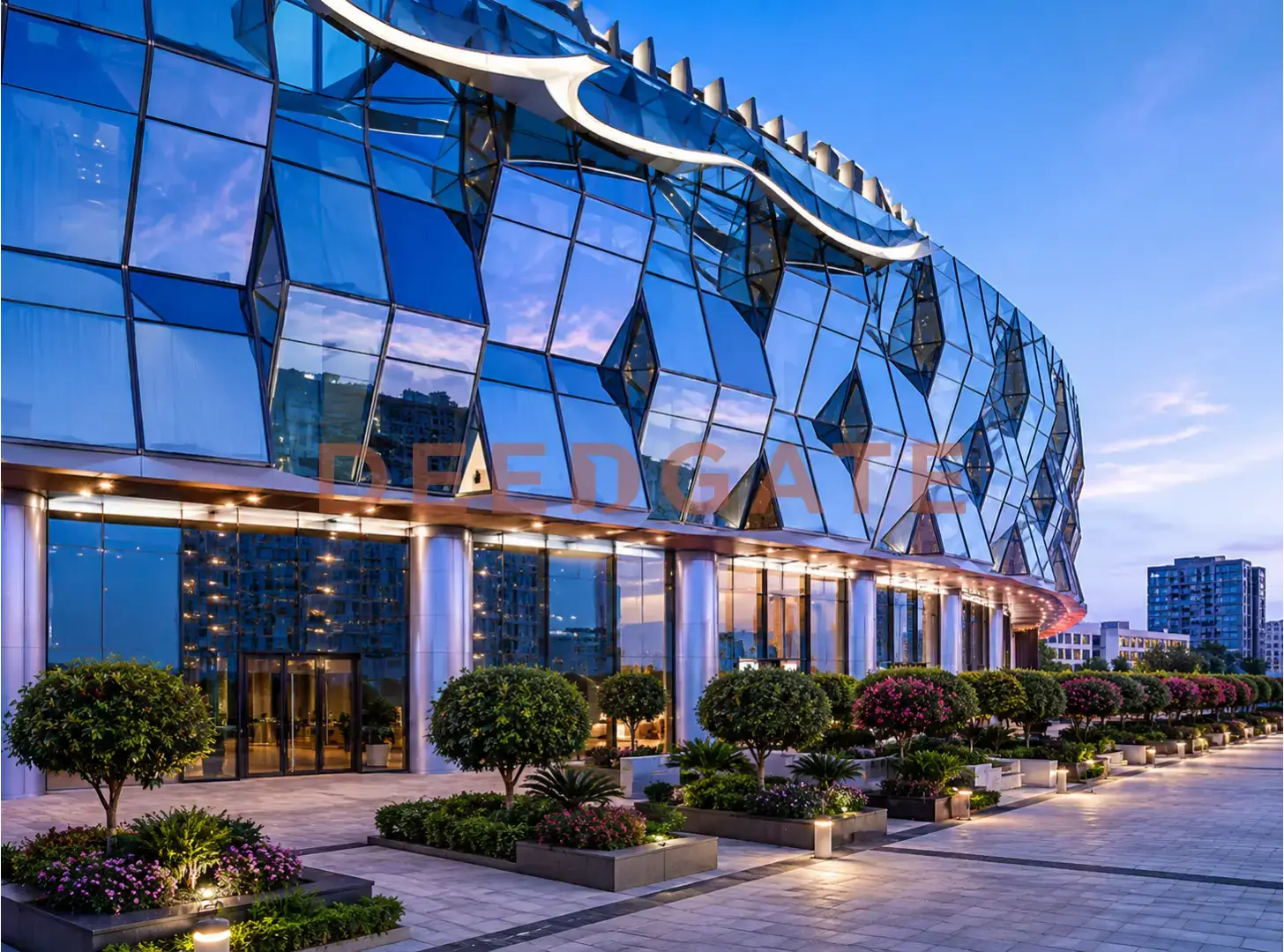
The Wave Mall New Cairo prices every first-phase unit at the same rate per square metre, regardless of floor or view. A ground-floor commercial unit and an equivalent unit on the third floor of this G+3 building carry an identical metre rate, which reverses the tiered pricing model almost every other mall on North 90th Street applies. El Masria Group Developments launched the project on that street beside the Lotus district in New Cairo (Fifth Settlement), offering retail units, administrative offices, medical clinics and a pharmacy inside a single 4,250 m² plot.
Administrative units at The Wave Mall New Cairo open at EGP 4,610,000, with a 10% contract down payment and instalments running to 10 years without interest. The compact plot limits how many units exist at all, which creates a supply constraint inside a district where commercial land has become scarce. What follows sets out the pricing policy, the payment structure, the indoor and outdoor areas per unit type, the handover terms, the location distances and the developer’s record, in that order, because for this project the pricing mechanics matter more than the marketing.
Why a flat price per meter changes the buying maths here
Commercial malls in the Fifth Settlement normally price by position. A shop at the entrance costs more per metre than one at the rear, a ground unit costs more than an upper one, and a unit facing the plaza costs more than a unit facing the service side. That gradient means two buyers in the same building can pay very different rates for identical floor areas, and it forces the buyer to negotiate position rather than product.
El Masria Group Developments removed that gradient from phase one entirely. Every unit of a given category carries the same metre rate, so the only variables left are area, finishing type and activity. For a buyer, this converts the purchase decision into a straightforward calculation: pick the size the business needs and the floor that suits the activity, then multiply. There is no premium to argue over and no discount to chase on a less desirable corner.
The consequence worth understanding is that flat pricing shifts value toward the positions that would normally cost more. An upper-floor office in a tiered building is cheaper per metre precisely because it is worth less in rental terms. Here the upper floors cost the same as the lower ones, so the buyer who wants an upper-floor clinic pays no discount, while the buyer who secures a well-placed ground unit captures the position premium without paying for it. Position still matters for rent, and under flat pricing it becomes a first-come advantage rather than a priced one.
The Wave Mall New Cairo prices and price per meter
The price per meter at The Wave Mall New Cairo starts from EGP 139,500 for administrative and medical units delivered fully finished, and from EGP 236,500 for commercial units delivered core and shell. Total unit values start at EGP 4,610,000 for an administrative unit and around EGP 20,080,000 for a commercial one. Prices are updated for 2026.
Reading those two rates side by side is instructive, because the commercial metre costs roughly 1.7 times the administrative metre despite being delivered in a rougher state. Core and shell means the buyer receives a structural envelope and pays separately for flooring, ceilings, services and shopfront, while the administrative and medical metre already includes a completed interior. The real gap in delivered cost is therefore wider than 1.7 times, and any comparison a buyer runs against another mall must normalise for finishing before it means anything.
The arithmetic behind the entry ticket is worth checking, because it tells a buyer what the cheapest available unit actually looks like. At EGP 139,500 per metre, the smallest 30 m² office computes to roughly EGP 4,185,000, while the published entry price of EGP 4,610,000 corresponds to a little over 33 m². The gap indicates that the smallest modules are either already allocated or priced with a minimum, so a buyer targeting the absolute floor should ask which specific areas remain at the entry rate before assuming a 30 m² unit is available.
Outdoor area changes the effective rate on the commercial tier in the same way. A 70 m² shop paying EGP 236,500 per indoor metre reaches roughly EGP 16,555,000, yet it operates across 103 m² once its 33 m² outdoor extension is counted, which brings the cost per usable metre down to around EGP 160,700. That recalculation matters most for food and beverage operators, whose covers per hour depend on total seating rather than on enclosed floor area alone.
A launch discount of up to 8% applies to units bought during the launch window. Both the discount and the flat metre policy are stated as launch-phase terms, so a buyer weighing this project against a slower decision should treat the current rate as a window rather than a standing price. Prices remain subject to change once the launch phase closes.
Payment plan and the two-stage down payment
El Masria Group Developments structured the plan to keep the opening cheque small and push the second payment well past contract. A buyer pays 10% at reservation, then a further 10% two years later, and settles the remainder across a full 10 years with no interest applied. Splitting the deposit across a two-year gap is the detail that separates this plan from the standard single 20% entry seen elsewhere on North 90th Street.
- 10% contract down payment on reservation.
- An additional 10% payable two years after contracting.
- The remaining balance across a full 10 years, interest-free.
- Launch-period discount of up to 8% on the unit value.
The practical effect on a buyer’s cash position is significant. Entering a commercial asset priced above EGP 4.6 million for a first cheque of roughly EGP 461,000 leaves the majority of the buyer’s capital free during the construction period, which is exactly when a business needs liquidity for fit-out or for a parallel commitment. The second 10% arrives at year two, by which point the project is well into construction and the buyer has had two years of visibility on delivery progress before committing further.
Interest-free instalment terms over a decade also change how the purchase compares against renting. An owner paying flat instalments while inflation runs through the wider economy sees the real weight of each instalment fall over the term, whereas a tenant faces periodic rent escalation on the same space. That comparison is the core argument for buying rather than leasing a small office or clinic in this district.
Unit types, indoor areas and outdoor extensions
Four product types sit inside the building, and two of them come with a dedicated outdoor area attached to the unit. Administrative offices span 30 m² to 117 m², medical clinics start from 30 m², commercial units run from 70 m² to 130 m² with an outdoor extension of 33 m² to 71 m², and a single pharmacy occupies 120 m² with a 47 m² outdoor area.
| Unit type | Indoor area (m²) | Outdoor area (m²) | Delivery condition |
|---|---|---|---|
| Administrative office | 30 to 117 | Not applicable | Fully finished |
| Medical clinic | From 30 | Not applicable | Fully finished |
| Commercial unit | 70 to 130 | 33 to 71 | Core and shell |
| Pharmacy | 120 | 47 | Core and shell |
Administrative offices start at 30 m², a module sized for a startup or a sole professional practice such as a lawyer, accountant or design consultancy. At the upper end, the 117 m² office accommodates a company with a larger headcount or a branch of an established firm. Full finishing on delivery means the tenant or owner begins operating immediately without a fit-out budget, which is the single largest hidden cost in a core and shell purchase.
Medical clinics follow the same finishing logic and start from 30 m². A clinic delivered ready to operate lets a physician open without the six to twelve week fit-out delay that a shell unit imposes, and the presence of a pharmacy on the ground floor completes the medical chain inside the building. Patients who consult upstairs fill prescriptions downstairs, which is a demand loop that benefits both tenants.
Commercial units are the only category with a meaningful outdoor allocation. A 70 m² shop with 33 m² of outdoor space and a 130 m² shop with 71 m² both gain roughly 45% to 55% additional usable area on the plaza, which is decisive for restaurants and cafés where outdoor seating drives a large share of covers. Core and shell delivery here is an advantage rather than a shortfall, since a food and beverage brand needs to build its own kitchen extract, service runs and identity from the structure up.
The pharmacy is a single 120 m² unit with 47 m² outdoors, positioned on the ground floor. A pharmacy of that size in a building containing a clinic band on three upper floors occupies an unusually defensible position, because it is the only such licence in the scheme and it faces both street traffic and internal medical footfall.
Finishing: fully finished offices against core and shell retail
The project splits its delivery condition by activity rather than applying one standard across the building. Administrative and medical units hand over fully finished and ready for immediate use, while commercial units and the pharmacy hand over core and shell so the operator can build the interior around a brand identity. That split is deliberate, and it reflects how the two tenant types actually behave.
An office tenant almost never wants to design an interior. A retail or food brand almost always does, because its interior is part of the product. Delivering both conditions in the same building removes the wasted spend that occurs when a developer finishes a shop to a generic standard and the incoming brand strips it out. For the buyer, the reading is that the office and clinic tiers carry no fit-out liability, while the retail tier should be budgeted with fit-out added on top of the EGP 236,500 metre rate.
When does The Wave Mall New Cairo hand over?
The Wave Mall New Cairo hands over within 3 years of contracting, with the delivery year recorded as 2029 on the project record. Administrative and medical units arrive fully finished and ready to operate, while commercial units and the pharmacy arrive core and shell for the owner to fit out to the activity.
A three-year construction period against a ten-year payment term means a buyer continues paying instalments for roughly seven years after taking possession, which is the structure that makes the plan workable. Rental income from an operating unit can service the later instalments, so the out-of-pocket burden concentrates in the first three years and eases once the mall opens. Any buyer should still confirm the delay-penalty clause in the contract, since the marketing material does not publish one.
Where does The Wave Mall New Cairo sit on North 90th Street?
The Wave Mall New Cairo sits directly on North 90th Street beside the Lotus district, on the axis that links the Fifth Settlement to the New Administrative Capital. The mall connects to the Ring Road, the Suez Road and the Mohamed Naguib Axis, reaching the American University in Cairo in about 12 minutes and Cairo International Airport in roughly 20 minutes.
North 90th Street functions as the commercial spine of New Cairo, carrying the highest concentration of service malls in the district and the heaviest daily traffic. A building on that street inherits exposure that no internal location can replicate, and it inherits it permanently rather than as a consequence of a single anchor tenant. The Lotus district beside it supplies a dense, fully occupied residential base whose residents use the street daily rather than seasonally.
- About 12 minutes from the American University in Cairo.
- Around 10 minutes from Cairo Festival City Mall.
- Roughly 20 minutes from Cairo International Airport.
- 2 minutes from Madinaty, Al Rehab, Mostakbal City and Diyar Compound.
- Direct connection to the Ring Road, the Suez Road and the Mohamed Naguib Axis.
The Mohamed Naguib Axis link deserves separate weight, because it ties the building into the road network serving the New Administrative Capital. A commercial unit here therefore draws from two catchments at once: residents of New Cairo, and the daily commuters moving between New Cairo and the new city. Malls positioned deeper inside the Fifth Settlement capture only the first of those flows, which narrows their customer base to a single population.
The Fifth Settlement itself ranks among the most urbanistically complete districts in New Cairo, holding delivered compounds, schools, universities and medical centres rather than land awaiting development. Commercial demand in a district at that stage is existing demand measured against a resident population, not demand projected from a masterplan. Available commercial plots along the main axes have been largely absorbed over the past few years, which is the structural reason a new building on North 90th Street carries scarcity value that a similar building in a newer district would not.
The residential ring and the competing malls
Four large residential entities sit within two minutes of the site. Madinaty and Al Rehab, both Talaat Moustafa Group communities housing hundreds of thousands of residents between them, Mostakbal City, the newer urban community expanding east of New Cairo, and Diyar Compound complete a ring of established and growing demand. That population base is what makes an office or clinic tenancy here viable from opening rather than after a build-up period.
On the competitive side, V40 District Mall and the commercial component of Gazoura Compound operate in the same catchment. The distinction The Wave Mall New Cairo carries against them is the combination of a flat metre rate and a 4,250 m² footprint. A smaller building releases fewer units, which limits how much of the same tenant category the scheme can absorb and protects each owner from internal competition inside their own mall.
Proximity to the American University in Cairo and to several schools and universities in the corridor adds a student and academic segment on top of the residential one. That segment concentrates on food, beverage and service retail, which maps directly onto the ground-floor units with outdoor plaza extensions rather than onto the office floors above.
The G+3 layout, the façade and the building systems
The building follows a G+3 configuration with three repeated upper floors above the ground plate. Retail units and the pharmacy occupy the ground floor to absorb the heaviest visitor flow, while administrative offices and medical clinics distribute across the first, second and third floors where a quieter working environment holds. Separating the activity by level rather than by wing keeps patient and client traffic away from shoppers without needing a second building.
Façades use toughened glass specified to insulate against both noise and dust, finished in neutral tones that reflect daylight into the units. Both properties translate into operating cost. Noise insulation matters on a street carrying the traffic volume of North 90th Street, dust insulation matters in a district still under active construction, and daylight reflection reduces the lighting and cooling load a tenant pays for every month.
Smart building systems run through the scheme. Electronic gates operate on facial recognition, lighting is centrally managed, and a camera network feeds a security system running 24 hours a day, with central air conditioning covering every floor. Access control at that level is a genuine requirement rather than a specification detail, because a building mixing public retail with private clinics needs to admit the first group freely while restricting the second.
Green areas, landscaping and an open plaza sit in front of the building. The plaza serves the ground-floor commercial units that need outdoor extension, and it gives the upper-floor offices and clinics an open outlook rather than a wall. On a 4,250 m² plot, allocating footprint to open space is a real trade against sellable area, and the developer accepted that trade to give the retail tier its outdoor value.
Facilities and operating services
Services divide across three categories: security, operational continuity and tenant comfort. Each was specified against the mixed-use character of the building, so the same package has to serve an office tenant, a physician and a café operator at once.
- Equipped meeting rooms and reception rooms serving the administrative units.
- Restaurants, cafés and a kids area that turn the mall into a family destination.
- Garages sized for hundreds of cars to keep congestion off the street frontage.
- High-speed internet and central air conditioning across every floor.
- Electronic gates operating on facial recognition, with 24-hour camera surveillance.
- Round-the-clock security personnel plus modern fire-fighting and emergency systems.
- Generators that start automatically during a power cut.
- Periodic maintenance and cleaning services.
- Dedicated storage space attached to some units.
Two items on that list solve problems specific to small malls. Automatic generators matter because a clinic mid-procedure or a restaurant mid-service cannot absorb an outage, and a small building rarely justifies the cost unless it is designed in from the start. Dedicated storage attached to units addresses the chronic shortage of back-of-house space in compact commercial buildings, where a tenant otherwise sacrifices sellable floor area to stock.
Read More: Compound Sodic Eastown Fifth Settlement
Parking capacity carries similar weight on this particular street. North 90th Street suffers heavy kerbside congestion, and a mall that pushes its visitors onto the street loses them to whichever competitor has a garage. Sizing the garage for hundreds of cars protects the ground-floor retail during the exact hours when the street itself is at capacity.
El Masria Group Developments and the Isola portfolio
El Masria Group Developments develops across the residential, commercial and administrative segments of the New Cairo market and has operated in Egypt for more than 35 years. The company’s stated approach is to run detailed site studies before acquisition, targeting plots with high surrounding population density and proximity to universities, medical centres and primary roads. The position of this project on North 90th Street beside the Lotus district follows that pattern exactly.
The Isola series forms the backbone of the portfolio and spans several districts. Isola Quattro and Isola Centra sit in the Fifth Settlement, Isola Villa in New Zayed, Isola Sheraton in Heliopolis, and a further Isola project in October Gardens, alongside the El Masria residential buildings in New Cairo. That geographic spread across four separate urban markets is a stronger indicator than project count alone, because each market imposes different permitting, contractor and absorption conditions.
Mixing residential and commercial development also matters for a buyer here. A developer that has delivered both understands the operating requirements of a retail tenant and the finishing standards a residential buyer expects, and a mixed-use building needs both. For an off-plan purchase with a three-year horizon, the developer’s ability to complete on schedule is the primary risk the buyer carries, and a documented multi-district record is the available evidence on that point.
Is The Wave Mall New Cairo a suitable investment?
Three factors support value over the medium term. The building sits on North 90th Street inside a district where commercial supply is constrained, it spreads income across retail, administrative and medical tenancies inside one asset, and the flat metre policy gives the buyer a transparent basis for calculating return from the day of contract.
Scarcity is the most underrated of the three. A 4,250 m² plot produces a finite and small unit count, and in a district where new commercial land has largely been absorbed, that limitation supports resale pricing more reliably than any amenity does. A large staged mall can dilute its own owners by releasing further phases into the same market. A single-phase building on a compact plot cannot.
Read More: Aisle 90 Fifth Settlement, Mall New Cairo
Income diversification across the three tenant categories also stabilises the asset. Clinics and offices sign longer leases and generate steady income insulated from consumer sentiment, while ground-floor retail captures the upside from visitor traffic and reacts faster in both directions. An owner holding one unit still benefits, because the building’s overall occupancy underpins the address, and a mall with a stable upper-floor tenancy stays a functioning destination even through a weak retail cycle.
The main consideration running against the project is the three-year handover. Anyone requiring rental income inside the first year should not buy here, since nothing is operational until delivery. The offsetting factors are the ten-year interest-free term and the opportunity for the unit’s value to appreciate before it ever opens, which is the standard off-plan trade in a rising district.
On buyer fit, the project suits an investor purchasing to lease or to resell after handover, and a professional planning to open an office, a clinic or a shop in a location that will be operational when they are ready. It suits less well a buyer needing immediate cash flow or a ready-to-occupy unit today. The flat metre rate and the launch discount are both launch-phase terms, so both are expected to move once that phase closes. This analysis is offered for guidance and is not investment advice.
Frequently asked questions about The Wave Mall New Cairo
What are the prices of units at The Wave Mall New Cairo?
Unit prices at The Wave Mall New Cairo start from EGP 4,610,000 for an administrative unit, at a rate of EGP 139,500 per metre for administrative and medical space and EGP 236,500 per metre for commercial space. A commercial unit starts from around EGP 20,080,000, updated for 2026.
What are the payment plans at The Wave Mall New Cairo?
The Wave Mall New Cairo requires a 10% down payment on contract and a further 10% two years later, with the balance spread across 10 years free of interest. A launch discount of up to 8% applies during the launch phase, which is expected to close before prices are revised.
What unit types are available at The Wave Mall New Cairo?
The Wave Mall New Cairo contains commercial units, administrative offices, medical clinics and a pharmacy. Offices run from 30 m² to 117 m² fully finished, commercial units from 70 m² to 130 m² with 33 m² to 71 m² outdoors, core and shell, and clinics start from 30 m².
Read More: Mall Golden Gate Fifth Settlement, New Cairo
Who is the developer of The Wave Mall New Cairo?
The developer of The Wave Mall New Cairo is El Masria Group Developments, active in Egypt for more than 35 years across residential, commercial and administrative projects. Its portfolio includes Isola Quattro and Isola Centra in the Fifth Settlement, Isola Villa in New Zayed and Isola Sheraton in Heliopolis.
What services does The Wave Mall New Cairo offer?
The Wave Mall New Cairo offers equipped meeting and reception rooms, restaurants and cafés, a kids area, garages for hundreds of cars, central air conditioning, high-speed internet, facial-recognition gates, 24-hour security and cameras, automatic generators, and fire-fighting and emergency systems.
Project summary
The Wave Mall New Cairo combines a North 90th Street address, a flat price per meter starting at EGP 139,500 across all first-phase units, and a compact 4,250 m² plot that limits the unit count in a supply-constrained district. A 10% down payment with 10 interest-free years keeps entry accessible for a first commercial purchase. To check updated prices or arrange a viewing, reach out through the form on this page.