
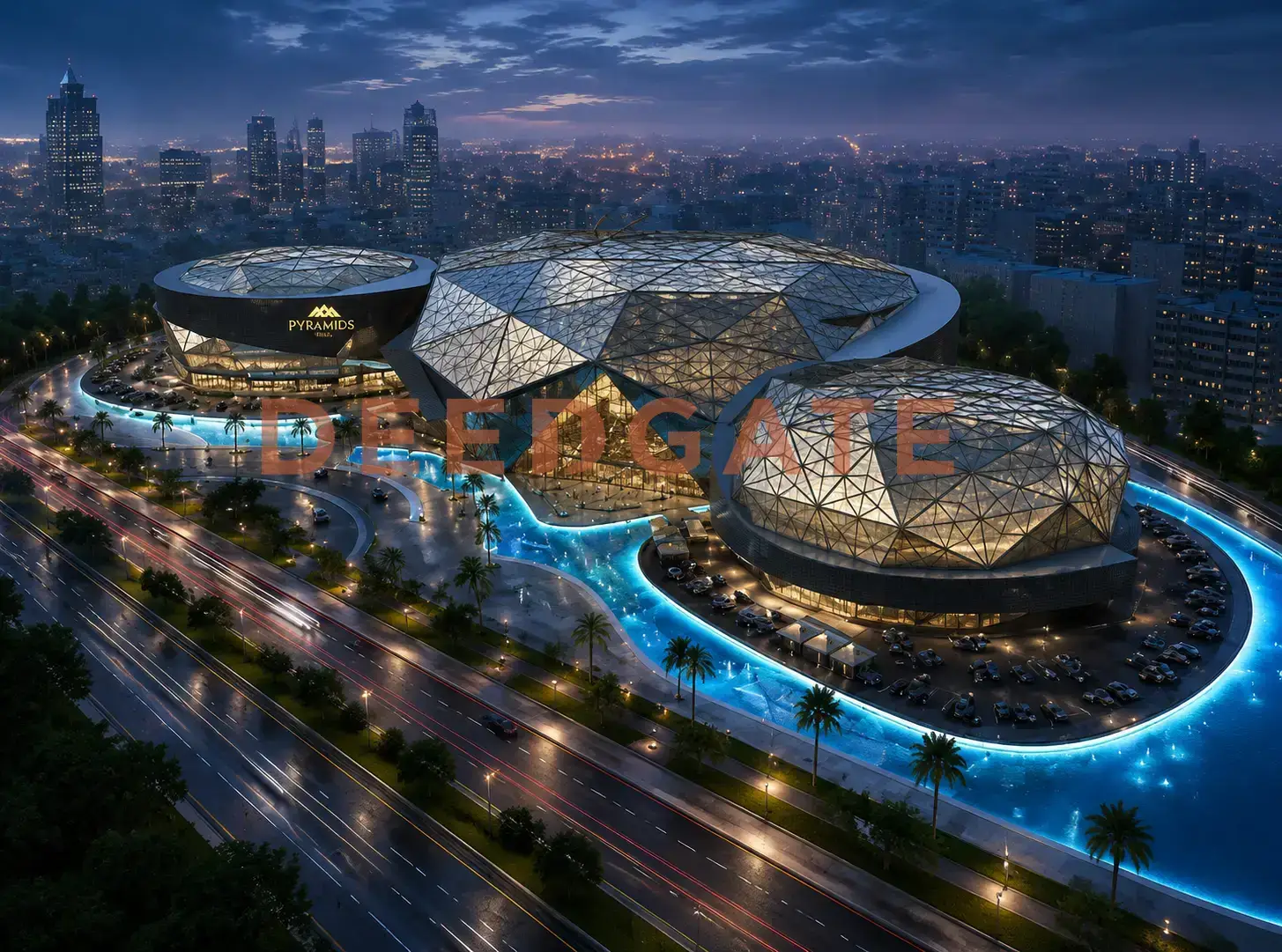
Mall Vertex New Capital is a non-residential commercial, administrative, and medical building developed by Pyramids Developments inside the MU23 zone of the Government District in the New Administrative Capital. The project pairs a guaranteed annual return of up to 27% on the down payment with a scarce position facing Al-Fattah Al-Aleem Mosque, placing it at the administrative core of the city rather than in a weekend retail cluster. This combination is what separates the project from the conventional Downtown malls that price purely on footfall.
The building spans 18,456 m² across a ground floor and nine upper storeys, ten levels in total. Prices start from EGP 5,400,000 for medical units and EGP 6,300,000 for commercial units, with a 20% reservation down payment, installments of up to 5 years, and a menu of more than 16 flexible payment systems. Pyramids Developments carries the plans, positioning the property for a long-term investor and for the clinic or office owner who wants to sit next to the ministries and embassies, not for a buyer chasing immediate weekend rent.
Why Mall Vertex New Capital works differently from other Downtown malls
The project differs from traditional Downtown malls on two measurable points. The first is a guaranteed return of 27% per year on the down payment, paid from the moment of contract until handover. The second is location: the tower sits inside the MU23 ministries zone rather than inside the entertainment-retail districts that most New Capital malls target.
Those two attributes move the property from the category of “a commercial mall” into the category of “an income-producing instrument before handover”. A buyer here begins collecting real income while the unit is still under construction, a payment pattern that is rare in the Egyptian market, where returns usually wait until delivery. The pre-paid yield, not a raised price per meter, is the mechanism the developer uses to attract capital.
The location classification compounds that difference. A mall on an entertainment axis lives or dies on weekend and evening footfall, which concentrates its revenue into a few days and leaves it exposed to seasonality. This tower instead sits among ministries, embassies, and the Egyptian Exchange, where demand is generated by people who arrive to work five days a week. Scheduled, repeatable demand of that kind is easier to underwrite than a weekend crowd, and it is the reason the project frames itself around the office and clinic tenant rather than the leisure shopper.
Location inside MU23, the heart of the Government District
The project occupies the MU23 zone of the Government District in the New Administrative Capital, the strip the New Urban Communities Authority set aside for mixed-use activity tied to the ministries belt. That planning classification is precisely what shapes the building. Its target consumer is not a weekend visitor but a government employee, a diplomat, and a businessperson who deals with the exchange and the ministries every working day from Sunday to Thursday, which produces a steady daily client base rather than a Friday spike.
The surrounding entities reinforce that daily traffic across the week. The tower faces Al-Fattah Al-Aleem Mosque directly, the largest mosque in the New Administrative Capital, which draws thousands of worshippers daily and tens of thousands during Friday prayers and religious occasions. It sits minutes from the Cathedral of the Nativity of Christ, placing the property on a dual religious and civic axis that moves visitors throughout the week.
- Wrapped by the ministry and government-authority buildings where tens of thousands of employees work, forming a fixed daily customer base for the commercial and administrative activity.
- Close to the district of international embassies and consulates, which specifically supports the medical and administrative units aimed at a high-income segment.
- A short distance from the new Egyptian Exchange, drawing brokerage firms, accountants, and financial advisers as tenants for the administrative floors.
- Within a connected commercial cluster that includes Bloc Hub Tower and Nidit Tower, which multiplies the area’s pull as a shopping and business destination.
The Government District that frames the tower is the anchor of the whole New Administrative Capital. It gathers the cabinet, the House of Representatives, and dozens of ministerial complexes housing 34 ministries, and government bodies have already begun relocating their headquarters into the district in successive waves. A mall sitting inside a working administrative capital carries a fundamentally different demand profile from one on a residential axis: its footfall comes from employees, officials, and visitors who arrive to conduct business on fixed working days, so consumption is scheduled and repeatable rather than seasonal. The adjacent Downtown, spread over roughly 1,364 acres and split into specialized commercial segments, extends the catchment further, so the project draws on both the ministries belt beside it and the wider Downtown business population.
Architecture and floor plan
The building takes the form of one ground floor plus nine upper storeys, ten levels in total, split by a clear functional division that keeps the commercial visitor apart from the clinic patient and the office user. Pyramids Developments engaged international design houses for the layout, and the modern glass facades give the tower a visual identity that matches the formal government character of the zone.
| Floors | Activity | Unit type |
|---|---|---|
| Ground to third | Commercial | Shops and showrooms |
| Fourth to ninth | Administrative and medical | Offices and clinics |
This vertical separation between the three activities is a practical advantage for the investor. A clinic on the fifth floor is not disturbed by the noise of a showroom on the ground floor, and an administrative office does not share an elevator with restaurant customers. Each activity keeps its own identity without losing the benefit of sitting inside one integrated complex.
The choice of glass facades is more than an aesthetic decision in this location. The Government District is built to a formal, institutional visual language, and a curtain-wall exterior lets the building read as part of that fabric rather than as a standalone retail box. Engaging international design houses at the layout stage also matters for a mixed-use building, because separating three circulation types cleanly, the shopper, the patient, and the office worker, is a planning problem before it is a styling one. The functional zoning that results is what allows the ground-to-third retail and the fourth-to-ninth offices and clinics to coexist without their traffic colliding.
Unit sizes and how the tower is divided
The total 18,456 m² footprint was planned to raise the count of small and medium units so it suits founders of early-stage businesses, instead of limiting the spaces to large corporates only. Unit divisions vary by activity type and begin from a very low minimum compared with most competitors in the zone, which widens the pool of buyers who can enter the project. Spreading the area over ten levels rather than a single sprawling floorplate is what makes those small cuts possible, since each storey can be subdivided independently for the activity it carries.
| Unit type | Area starts from | Target activity |
|---|---|---|
| Commercial | 10 m² | Shops, cafes, and small showrooms |
| Administrative | 27 m² | Company and consultant offices |
| Medical | 27 m² | Specialist clinics and physicians |
The commercial units span the ground to third floors and start from 10 m², a footprint small enough for a single-brand kiosk, a cafe, or a compact showroom that lives on the daily foot traffic of ministry and Downtown staff. The administrative units begin at 27 m² on the fourth to ninth floors and target company back-offices, consultants, and the financial-services firms drawn by the nearby Egyptian Exchange. The medical units share the upper band at a 27 m² minimum and are served by dedicated medical elevators, which suits specialist clinics and physicians who need patient and equipment movement kept separate from retail circulation.
What is the price per meter at Mall Vertex New Capital?
The price per meter at the project starts from EGP 200,000 for medical units and EGP 350,000 for commercial units, figures updated in April 2026. The total price starts from EGP 5,400,000 for a medical unit and from EGP 6,300,000 for a commercial unit, with a cash discount of up to 10% for outright purchase.
| Unit type | Price per meter (EGP) | Total price starts from |
|---|---|---|
| Commercial | 350,000 | EGP 6,300,000 |
| Medical | 200,000 | EGP 5,400,000 |
| Administrative | On request | On request |
Setting a medical price per meter at EGP 200,000 inside the Government District places the project in a lower price band than many Downtown competitors, even though the location factors are equal. The most likely reason is that Pyramids Developments leaned on the guaranteed-return mechanism as a marketing tool instead of raising the price per meter, so the buyer receives a 27% annual yield against a controlled, unexaggerated rate.
Payment and installment systems
Pyramids Developments released more than 16 different payment systems for the project, an unusual number against the average of four to six systems most developers in the zone offer. The purpose of this variety is to let each investor tune the first installment and the tenor to personal cash flow, rather than imposing a single uniform schedule. The core announced terms are set out below.
Read More: Mall Spire Tower New Capital
- A reservation down payment starting from 20% of the total unit value.
- Installments on the remaining value over a period of up to 5 years with no declared interest.
- A cash discount of up to 10% of the unit value on outright payment.
- A guaranteed annual return on the down payment of up to 27% per year until the handover date.
- More than 16 distinct payment systems to adjust the installment and tenor to the buyer’s situation.
The guaranteed 27% annual return on the down payment means, in practice, that an investor who pays a down payment of one million pounds collects EGP 270,000 per year before receiving the unit. Across a waiting period of three to four years until handover, the return on the down payment alone will have covered part of the value of the installments themselves.
When are the units delivered?
The project follows a dual delivery schedule set by Pyramids Developments: three years for the commercial units and four years for the administrative and medical units. This means the commercial portion is delivered before 2030 and the administrative and medical units by 2030. The schedule is contractually binding within the announced terms.
The staggered handover carries a practical read for the buyer. Delivering the commercial floors first lets the ground-to-third retail begin operating and generating rent while the upper administrative and medical floors are still being finished, so the building is not idle in a single all-at-once handover. It also aligns with the daily traffic model: the retail base opens into a district that is already occupied by working ministries, then the office and clinic floors follow as the surrounding administrative population continues to grow.
Facilities and services
Pyramids Developments equipped the project with a services system that serves the three activities at once: the retail shopper, the clinic patient, and the office employee. The provisions are split between technical infrastructure, security systems, and user comfort, tuned to the standard a diplomatic zone requires.
- Security: a 24/7 system with CCTV coverage of every entrance and corridor, plus a guard team trained on government-zone protocols.
- Parking: a large multi-storey garage fitted with an electronic guidance system to find vacant spaces, cutting congestion at the entrances during peak hours.
- Elevators: a high-speed network including panoramic elevators for visitors and dedicated medical elevators on the clinic floors for moving patients and equipment.
- Fire systems: automatic sprinklers, multiple emergency exits, and early-warning alarms to civil-defence specifications for mixed-use buildings.
- Internet and communications: an internal fiber-optic network serving the administrative and medical units that depend on fast, stable data transfer.
- Food and beverage: a restaurants and cafes zone on the lower floors serving retail visitors and office and clinic staff during break times.
- Maintenance and cleaning: a periodic maintenance team and a cleaning crew working around the day to hold the building to the level a diplomatic area demands.
How the project compares with the surrounding malls
Set against the other malls in its cluster, the tower competes on the axis of use and yield rather than on scale. Bloc Hub Tower and Nidit Tower share the same MU23 catchment, so the three feed a single business and shopping destination instead of splitting demand. Within Pyramids Developments’ own New Administrative Capital portfolio the contrast is sharper still: Mega Mall and Pyramids Mall are large footfall-led destinations on the entertainment axes, while this building is a compact ministries-belt asset. That difference is the point for a buyer weighing daily, scheduled demand against weekend peaks.
The clearest lever separating it is the pre-handover income. Where a footfall-led mall asks the buyer to wait until operation for a return, this project pays up to 27% annually on the down payment from contract, so the holding period itself carries a yield. For an investor comparing malls in the same city, the decision often reduces to whether they value a larger retail spectacle or a smaller, ministries-anchored unit that begins earning before the doors open.
Pyramids Developments, the developer behind the project
Pyramids Developments is a developer that has built a wide presence in the New Administrative Capital market specifically, with activity extending to 6th of October, the North Coast, and Ain Sokhna. The company’s geographic focus on the New Administrative Capital gives it precise knowledge of the plots and zones that carry real investment value against those priced only on paper. That focus is a meaningful risk-reducer for a buyer entering a project still under construction.
The portfolio shows the company treats real estate development with a “chain” logic rather than a “single project” one, which in theory lowers the risk of a halt or delay, because continued work on a new project is tied directly to the reputation of the previous one and its adherence to announced delivery dates. Within the New Administrative Capital alone, the company combines commercial and administrative projects such as Pyramids Mall, Mega Mall, Pyramids Business Tower, and Lake Studios alongside Vertex, a concentration that gives it detailed knowledge of each sector’s masterplan and working relationships with the contractors and consultants approved by the city authority. Its named past projects include the following.
- Pyramids Mall New Capital and Pyramids Business Tower New Capital.
- Mega Mall New Capital and Lake Studios New Capital.
- Champs Elysees Mall, Grand Square Mall, and Paris Mall and Paris East Mall in the New Administrative Capital.
- Pyramids City 5 October and La Capitale Compound in the New Administrative Capital.
- La Capitale Suite Lagoons, La Capitale New El Alamein, and La Capitale El Sokhna.
- Sky City El Galala Resort on the Ain Sokhna and Galala axis.
Read as a whole, the portfolio matters to a buyer here for a specific reason: it is the evidence base for the delivery promise. A developer running five commercial and administrative projects in the New Administrative Capital at once has already priced contractors, cleared consultant approvals with the city authority, and delivered earlier phases whose reputation is now attached to the next launch. That operational accumulation is a concrete risk-mitigation factor for a building still under construction, because a halt or a slipped handover would damage the sales of every sister project. The chain logic gives the developer a direct commercial incentive to honour the announced schedule.
Investment analysis of Mall Vertex New Capital
Gathering the announced facts about the project produces a specific, measurable investment picture, away from generic marketing language. The points below rest on the numbers stated in the earlier sections rather than on opinion.
- Pre-paid yield: the 27% annual return on the down payment lets the investor begin collecting real income before the unit operates, a pattern rare in an Egyptian market that usually waits until handover.
- A fixed daily client base: the presence of government employees, diplomats, and exchange participants guarantees daily consumer traffic, an advantage weekend-oriented malls do not have.
- Activity diversity: merging commercial, administrative, and medical activity in one building lowers vacancy risk, since if retail rents weaken in a period the administrative and medical floors keep driving revenue.
- Price per meter against the zone: EGP 200,000 for a medical meter in the Government District places the project in a reasonable price band relative to MU23 competitors, which may support capital-value growth as units are delivered.
- The risk: the waiting period until delivery of three to four years requires the investor to sustain long installments without rental income, partly offset by the guaranteed return on the down payment.
The project suits the long-term investor seeking an income-producing asset in a stable government area, and the clinic or office owner who wants to be near the ministries and embassies. It is less suited to a buyer seeking immediate rental income, or one who needs a commercial unit opening directly onto a main street instead of an enclosed multi-storey mall. This analysis is for guidance only and is not an investment recommendation; the final decision depends on the investor’s financial position, goals, and a review of the project’s legal documents.
Read More: G3 Mall New Capital
Frequently asked questions about Mall Vertex New Capital
How much is a unit at Mall Vertex New Capital?
Unit prices at Mall Vertex New Capital start from EGP 5,400,000 for a medical unit and from EGP 6,300,000 for a commercial unit, at a price per meter of EGP 200,000 medical and EGP 350,000 commercial. Prices were updated in April 2026 and change with the chosen payment system.
Where exactly is Mall Vertex New Capital located?
Mall Vertex New Capital is located in the MU23 zone of the Government District in the New Administrative Capital, directly facing Al-Fattah Al-Aleem Mosque and next to the Cathedral of the Nativity of Christ, within the axis of ministries, embassies, and the Egyptian Exchange, and close to Bloc Hub Tower and Nidit Tower.
What payment system is available at Mall Vertex New Capital?
Mall Vertex New Capital offers more than 16 payment systems, each starting with a 20% down payment of the unit value and installments of up to 5 years. The offers include a cash discount of up to 10% on outright payment, plus a guaranteed annual return on the down payment of up to 27% until the handover date.
When are the units of Mall Vertex New Capital delivered?
Mall Vertex New Capital delivers its commercial units within three years of the contract date, while the administrative and medical units are delivered within four years, that is in 2030. The timeline is contractually binding as announced by Pyramids Developments, the developer behind the project.
Is Mall Vertex New Capital residential or commercial?
Mall Vertex New Capital is a fully non-residential project combining three activities: commercial on the floors from ground to third, and administrative and medical from the fourth to the ninth. The project holds no residential units, and its position in the Government District is designated for mixed administrative and commercial use.
Conclusion
Mall Vertex New Capital puts a verifiable equation in front of the investor: a Government District position in MU23 opposite Al-Fattah Al-Aleem Mosque, three activities spread across 18,456 m², prices from EGP 5,400,000, and a 20% down payment with a guaranteed 27% annual return and installments up to 5 years. This mix makes the property a long-term investment instrument rather than a plain commercial space. To ask about updated prices, payment systems, or to book a viewing, get in touch through the contact form at the bottom of this page.
Read More: MAS Tower Mall New Capital