
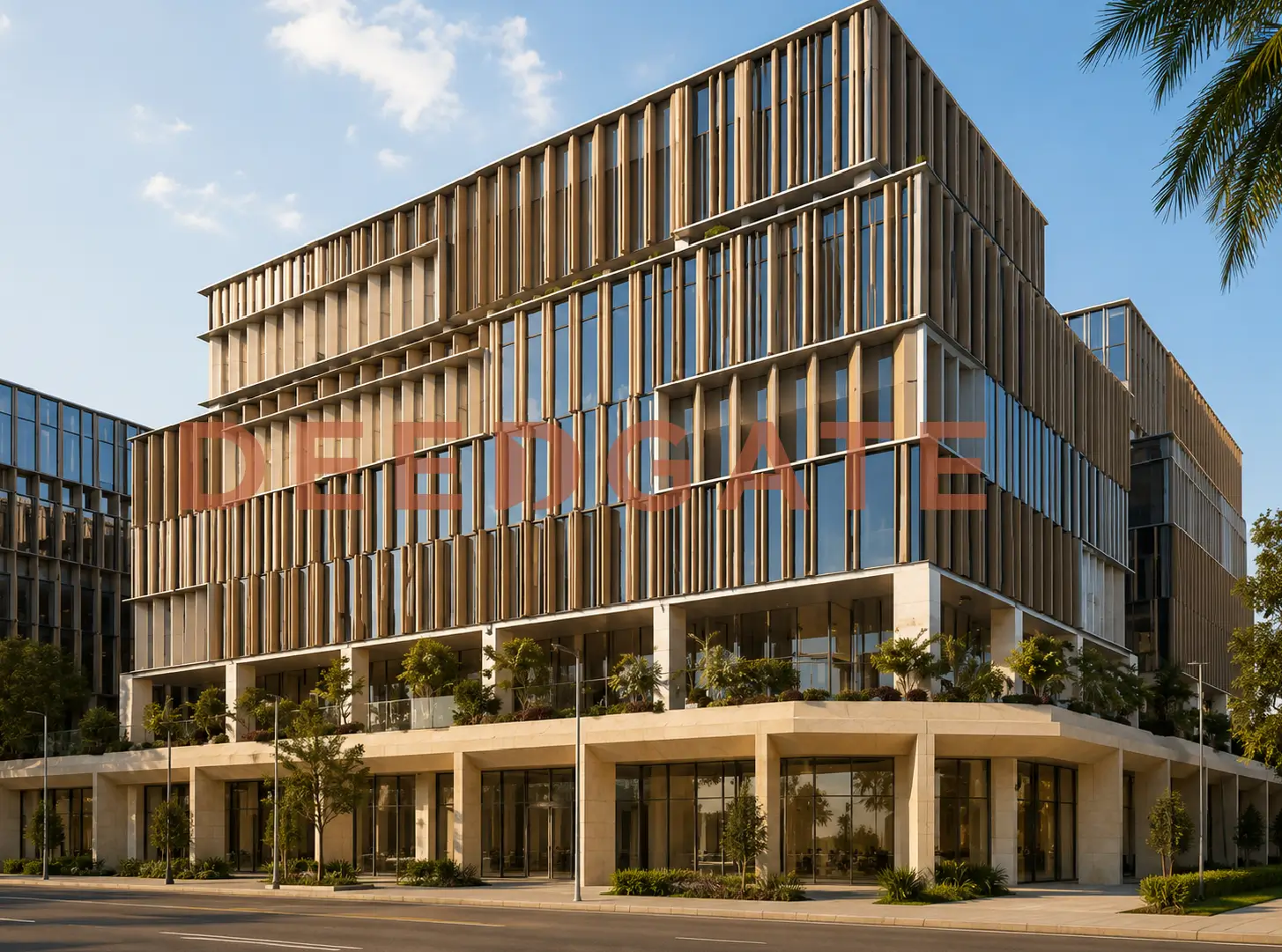
East Point 1 Mall New Cairo is a commercial, administrative and medical mall developed by Capital Hills Developments on a 2,600 m² plot in the First District of New Cairo (Fifth Settlement), at a branch off Axis 79 beside As-Salam International Hospital. What separates it from most retail launches in the district is that its catchment already exists. The First District is a settled, fully occupied residential quarter, and the hospital next door generates a daily flow of patients, visitors and staff that does not depend on a future population arriving.
Capital Hills Developments prices entry units at East Point 1 Mall New Cairo from EGP 4,600,000 for an administrative office and from EGP 5,000,000 for a commercial unit, with seven payment structures that begin at zero down payment and stretch to ten years. The building is small by mall standards, at two basements, a ground floor and three repeated upper levels, and the developer assigned each activity its own floors rather than mixing shops and offices on the same plate. This page sets out every figure the developer has published, and is equally explicit about the figures it has not.
Where East Point 1 Mall sits, and why the First District address matters
The mall occupies a plot in the First District of New Cairo, on a branch road off Axis 79, one of the internal corridors that feeds the core of the Fifth Settlement into the wider New Cairo road network. Its immediate neighbour is As-Salam International Hospital, the New Cairo facility of the Alameda Healthcare group, which operates from Street 15 in the same First District and opened in 2022. A working tertiary hospital next door is the single most consequential fact about this location, because it produces footfall on a weekday morning in January exactly as it does on a weekend in July.
The First District is one of the older and denser residential quarters of the Fifth Settlement, built out and occupied rather than under construction. That distinguishes the mall from retail schemes launched on the eastern extensions of New Cairo, where the resident base that will eventually support the shops has not yet moved in. For an owner intending to lease, the difference shows up in how long a unit sits empty after handover rather than in the purchase price.
The developer lists the following axes and landmarks as the reference points around the mall. Note that Capital Hills Developments publishes these as proximities and does not attach a distance in kilometres or a drive time to any of them, so the list below reproduces the relationships without inventing measurements.
- The Ring Road, the orbital that ties New Cairo to the rest of Greater Cairo.
- The Mohamed Naguib Axis, the main east to west spine linking the Fifth Settlement to its eastern extensions.
- The American University in Cairo, whose New Cairo campus is one of the largest single traffic generators in the district.
- Cairo Festival City, the nearest large-format retail benchmark in New Cairo.
- The New Administrative Capital, reachable through the eastern axes.
- Cairo International Airport, connecting the district to business and travel movement.
Three separate demand sources therefore overlap on this plot: a residential population inside the First District, a hospital catchment that arrives for medical reasons, and passing traffic on Axis 79. A mall that draws on a road frontage alone carries a single point of failure, because a change in traffic routing can remove its customers. Spreading the footfall across a resident base, a medical anchor and a through route reduces that exposure, though it does not eliminate it.
A 2,600 m² footprint split into two basements, a ground floor and three upper levels
East Point 1 Mall New Cairo spans 2,600 m² and rises as two basement levels, a ground floor and three repeated floors above it. Capital Hills Developments chose vertical separation over horizontal mixing, so the ground and first floors carry the commercial units while the second and third floors carry the administrative offices. The medical component sits within the same use mix, though the developer has not stated which level holds it.
Read More: V Terrace Mall New Cairo Fifth Settlement
The practical effect of that decision is circulation control. A shopper heading to a ground-floor café never crosses the corridor traffic of an office tenant, and a consultant arriving for a meeting on the third floor does not queue behind retail customers at the lift. In a building of this footprint, where every floor plate is modest, that separation matters more than it would in a large mall with room for separate cores.
The compact envelope has a second consequence that works in an owner’s favour. A 2,600 m² plot over four selling levels yields a limited number of units, and scarcity inside a single building strengthens the landlord’s position when a lease comes up for renewal. It also holds down the mall’s total running cost, since common-area cleaning, security and lift maintenance are spread over a smaller physical asset than a regional centre would require.
Two structural figures remain unpublished, and buyers should ask for both. Capital Hills Developments has not released the built-up area, the footprint of each floor plate, or a built-up to plot ratio, and it has not released the total number of units in the building. Without the unit count, the scarcity argument above stays qualitative rather than measurable, and without the built-up area no one outside the developer can calculate what proportion of the 2,600 m² is sellable space.
Unit types, floors and areas at East Point 1 Mall
The mall carries three investment activities: retail units on the lower levels, administrative offices on the upper levels, and a medical component within the overall use mix. Unit areas are customisable and begin at 42 m², a size that suits a single-operator shop, an individual office or a one-room clinic rather than a branch of a large chain. The table below sets out what the developer has published for each type.
| Unit type | Area starts from | Price starts from | Position in the building |
|---|---|---|---|
| Commercial units | 42 m² | EGP 5,000,000 | Ground and first floors |
| Administrative offices | 46 m² | EGP 4,600,000 | Second and third floors |
| Medical units | Not published | Not published | Within the mall use mix |
Commercial units on the ground floor take the direct frontage and the pedestrian movement that comes with it, which makes them the natural home for food and beverage operators and for brands that convert on impulse. The first floor carries the same commercial classification but sits behind that frontage, so it typically serves destination retail where the customer already intends to visit. The pricing published by Capital Hills Developments does not distinguish between the two commercial levels, so a buyer should confirm whether the EGP 5,000,000 entry applies to a ground-floor unit or a first-floor one.
Administrative offices on the second and third floors trade frontage for quiet, which is the correct trade for service businesses, consultancies and small professional practices whose clients arrive by appointment. Their 46 m² floor is four square metres above the commercial floor, and the mall’s meeting rooms and high-speed internet are aimed squarely at this tenant profile. The medical units draw on the hospital next door, since a clinic that sits within walking distance of As-Salam International Hospital inherits part of an existing patient flow rather than building one from nothing.
The medical row is the weak point in the published data, and it is worth stating plainly. Capital Hills Developments markets a medical component but has released neither a minimum area nor a starting price for it, and has not named the floor it occupies. A buyer evaluating a clinic here is therefore working without the two figures that would let them compare it against any other medical unit in the Fifth Settlement.
How much does a unit at East Point 1 Mall New Cairo cost?
Units at East Point 1 Mall New Cairo start from EGP 4,600,000 for an administrative office and from EGP 5,000,000 for a commercial unit, on prices updated in February 2026 and stated as subject to change. Capital Hills Developments quotes these as total entry tickets per unit type. It publishes no rate per square metre and no separate cash price.
That distinction decides how the figures should be read. The developer has not published a price per metre, has not announced a discount that would make these a zero-discount list price, and has not split the quote into a cash price and an instalment price. Whether a maintenance deposit is charged on top, and at what percentage, is also absent from the published material, so the two figures above should be treated as the entry cost of the unit alone and not as the total cost of acquiring it.
The two tickets behave differently when checked against their own area floors. Dividing the EGP 4,600,000 administrative entry by the 46 m² administrative floor returns exactly EGP 100,000 per square metre, so that ticket lands cleanly on the bottom of its own area band. The EGP 5,000,000 commercial entry divided by the 42 m² commercial floor returns roughly EGP 119,000 per square metre, which is not a round rate, and applying the administrative figure of EGP 100,000 to a 42 m² shop would price it at EGP 4,200,000, a full EGP 800,000 below the published commercial entry. Either commercial space carries a materially higher rate than office space here, which frontage would justify, or the EGP 5,000,000 ticket corresponds to a unit larger than the 42 m² floor. The developer publishes neither answer, and both of those per-metre numbers are arithmetic drawn from the two published figures rather than rates quoted by Capital Hills Developments.
On market position, the source material places entry tickets for competing commercial projects in the same part of New Cairo between EGP 4.4 million and EGP 6 million per unit. The EGP 4,600,000 administrative entry sits in the lower half of that band, below its EGP 5.2 million midpoint, though it is not the cheapest entry available in the district. A buyer comparing options should weigh that ranking against unit size, because a cheaper ticket on a smaller floor can still carry a higher rate per square metre.
The seven payment plans, and what each one actually costs per month
Capital Hills Developments released seven payment structures for the mall, beginning at zero down payment and lengthening as the down payment rises. The published terms are:
- No down payment, with the full price paid over 5 years.
- 10% down payment, with the balance over 6 years.
- 15% down payment, with the balance over 7 years.
- 20% down payment, with the balance over 8 years.
- 25% down payment, with the balance over 9 years.
- 30% down payment, with the balance over 10 years.
- 40% down payment, with the balance over 5 years starting after delivery.
Headline percentages tell a buyer very little until they are converted into cash. The table below applies each plan to the EGP 4,600,000 administrative entry ticket and assumes equal instalments across the stated term, which is the arithmetic implication of the published terms rather than a schedule the developer has confirmed.
| Down payment | Cash at contract | Balance financed | Term | Monthly equivalent |
|---|---|---|---|---|
| 0% | EGP 0 | EGP 4,600,000 | 5 years | EGP 76,667 |
| 10% | EGP 460,000 | EGP 4,140,000 | 6 years | EGP 57,500 |
| 15% | EGP 690,000 | EGP 3,910,000 | 7 years | EGP 46,548 |
| 20% | EGP 920,000 | EGP 3,680,000 | 8 years | EGP 38,333 |
| 25% | EGP 1,150,000 | EGP 3,450,000 | 9 years | EGP 31,944 |
| 30% | EGP 1,380,000 | EGP 3,220,000 | 10 years | EGP 26,833 |
| 40% | EGP 1,840,000 | EGP 2,760,000 | 5 years after delivery | EGP 46,000 |
Read down the final column and the ranking is not the one the down payments suggest. The 30% plan produces the lightest monthly commitment at roughly EGP 26,833, because ten years is the longest term on offer. The 40% plan demands the largest cheque at contract yet still carries a monthly figure close to EGP 46,000, since its balance is compressed into five years rather than ten.
The 40% plan earns its place for a different reason. Its instalments begin after delivery, which means an owner can take possession, find a tenant and start collecting rent before the payment clock starts. That sequencing matters to a buyer who intends to lease rather than occupy, because it lets rental income carry part of the instalment instead of coming entirely from outside cash flow.
One further point deserves attention before any plan is chosen. Capital Hills Developments publishes a single entry ticket per unit type and does not state a different price for a longer term, so on the published figures the nominal total is identical across all seven structures. Whether the developer applies a discount for paying in cash, or an uplift for stretching to ten years, is not disclosed, and it is the first question to put to the sales team, because it changes which of these seven plans is actually the cheapest.
Does East Point 1 Mall publish a rental yield or a guaranteed return?
East Point 1 Mall New Cairo publishes no rental yield, no return on investment percentage, no payback period and no guaranteed return. Capital Hills Developments has not released an expected rent per square metre, an occupancy forecast, or a rental guarantee naming a guarantor and a term. Every return figure quoted about this mall elsewhere is therefore unsourced.
This absence is worth stating rather than glossing over, because a yield is arithmetic and not a promise. A yield is annual rent divided by purchase price, and no one can calculate it for this project without the rent figure, which the developer has not supplied. Any percentage a broker attaches to this mall is therefore an estimate built on an assumed rent, and it should be treated as the broker’s assumption rather than as a developer commitment.
What the developer does offer is a qualitative case rather than a numeric one, and it rests on facts stated earlier on this page. The catchment exists already, the activities are separated by floor, the unit count is small, and the entry ticket sits in the lower half of the district’s published range. Those four conditions support an argument about leasing speed and landlord bargaining power, but they do not produce a percentage, and no percentage should be inferred from them.
A buyer who needs a return figure before committing has one practical route: ask Capital Hills Developments in writing for the rent per square metre it is projecting for each floor and the basis of that projection, then divide by the ticket themselves. Anything less specific is marketing language, and a contractual rental guarantee is only meaningful when the document names who is guaranteeing the payment and for how many years.
Services and operating systems inside the mall
Capital Hills Developments equipped the mall with an operating package aimed at keeping commercial, administrative and medical units trading without interruption. The published facilities are:
- Electronic gates regulating entry and exit and preventing congestion at peak times.
- A smart building management system controlling the mall’s facilities.
- An open plaza area for activities and events.
- Escalators and panoramic lifts connecting the floors.
- Cafés and restaurants serving unit owners and visitors.
- Retail units allocated to international brands.
- High-speed internet networks serving the administrative floors.
- Equipped meeting rooms available to office tenants.
- ATMs on site for financial transactions.
- Cleaning and maintenance teams operating around the clock.
- Security and guarding services 24 hours a day.
Two items on that list carry more commercial weight than the rest. Round-the-clock maintenance and a smart management system indicate that the mall is intended to be run as an operating asset rather than sold off and left to a residents’ committee, and that distinction is what preserves occupancy and unit value across the years after handover. The meeting rooms and internet provision are aimed directly at the second and third floors, since a consultancy or service firm choosing between two similar offices will pick the one where it does not have to build its own infrastructure.
One element of the operating picture is missing. Capital Hills Developments has not named the facility management or operating company that will run the mall after handover, and it has not published the annual maintenance charge or the percentage on which that charge is calculated. For a commercial owner those two figures feed directly into net income, so they belong in the same conversation as the purchase price rather than after it.
Capital Hills Developments, the developer behind East Point 1 Mall
Capital Hills Developments is the Egyptian developer of East Point 1 Mall New Cairo, founded by the engineer Mohamed Salah AbdelQader. Its published portfolio leans clearly towards commercial and administrative assets rather than residential ones, which makes its track record directly relevant to this project rather than merely adjacent to it. A developer whose experience is in selling apartments is learning a different business when it builds a mall, and that is not the situation here.
Read More: elev8 mall new cairo
The company has repeated the commercial and administrative mall format across several Egyptian markets rather than building a single one-off scheme. Its published mall portfolio comprises four projects:
- Park Yard Mall in 6th of October City.
- Point 9 Mall in the New Administrative Capital.
- Point 11 Mall in the New Administrative Capital.
- Park Point Mall in the New Administrative Capital.
Repeating one asset class across four locations builds accumulated knowledge in activity zoning, tenant mix and day-to-day operation, and that lowers the operational risk carried by an individual unit owner compared with buying into a developer’s first attempt at the format. The naming convention across that portfolio also explains this project’s title, since Capital Hills Developments numbers its schemes as a matter of house style, and the numeral in the name is part of the brand rather than a phase label added by a broker. For the engineering design of this mall the developer appointed IEC as consultant.
One fact about the developer cannot be stated with confidence, and it is better acknowledged than guessed. Published sources disagree on the year Capital Hills Developments was established, so no founding year is asserted here and no claim about the number of years the company has been trading should be built on one. What can be verified is the portfolio itself, and for a buyer assessing delivery risk the more useful exercise is to ask which of the four malls above have actually handed over units and on what schedule.
What the developer does not publish
Most pages about this project list what is available and stop there. The gaps matter just as much when the decision involves a commitment that can run for ten years, so they are collected here in one place rather than scattered through the text.
- Delivery date. No handover year is published, even though the seventh payment plan is defined as five years of instalments beginning after delivery. That plan cannot be evaluated until the date is known.
- Finishing standard. The developer has not stated whether units are delivered core and shell, semi-finished or fully finished, which can shift an owner’s fit-out budget by a large margin.
- Price per square metre. Only total entry tickets are published, so units of different sizes cannot be compared on a like-for-like rate.
- Medical unit areas and prices. A medical component is marketed with neither a minimum area nor a starting price attached to it.
- Maintenance charge. No maintenance percentage or annual service charge is disclosed, and maintenance is normally billed on top of the unit price.
- Operating company. No facility management or mall operating company is named for this project.
- Unit count and built-up area. Neither the number of units nor the built-up area is published, so the scarcity argument cannot be quantified.
- Delay penalty. No compensation clause for late handover is described in the published material.
None of these gaps is unusual for an Egyptian commercial launch, and none of them is disqualifying on its own. They are simply the questions that belong in the first meeting with the sales team, and the answers should arrive in the reservation form and the contract rather than in a brochure.
Read More: Aisle 90 Fifth Settlement, Mall New Cairo
Who the mall suits, and who it does not
East Point 1 Mall New Cairo fits an individual investor buying a small commercial, administrative or medical unit to lease, with a budget starting around EGP 4.6 million and a preference for holding cash rather than committing it at contract. The zero down payment structure lowers the entry barrier to the first instalment alone, which suits a buyer who wants exposure to New Cairo commercial property without liquidating other positions. It also fits an owner-operator, a clinic, a consultancy or a small practice looking for premises inside a populated district without paying the ticket that a large New Cairo mall commands.
It suits several buyers considerably less well. Anyone needing a large floor plate will find the 42 m² and 46 m² entry sizes and the 2,600 m² building too small to accommodate them, and a retailer seeking a pure high-street frontage without offices and clinics overhead is looking at the wrong format, because mixed use is the defining characteristic of this building rather than an afterthought. A buyer who requires a contractual delivery date before signing should also wait, since that date is not currently published.
The investment case, stated honestly, rests on four verifiable facts and no projections: an existing residential catchment in the First District, a working hospital next door supplying medical footfall, strict vertical zoning that protects each activity’s circulation, and an entry ticket in the lower half of the district’s published range. Against those sit the unpublished delivery date, the unpublished finishing standard and the absence of any rent or yield figure. Weighing the two lists is the buyer’s decision, and it should be made with the contract in hand.
This analysis is provided for guidance only and does not constitute investment advice. All figures are those published by the developer as of February 2026 and are subject to change.
Frequently asked questions about East Point 1 Mall
Where exactly is East Point 1 Mall located?
East Point 1 Mall New Cairo sits in the First District of the Fifth Settlement, on a branch off Axis 79, directly beside As-Salam International Hospital. The surrounding quarter is already built out and occupied, and the mall connects to the Ring Road, the Mohamed Naguib Axis, the American University in Cairo and Cairo Festival City.
Who is the developer of East Point 1 Mall?
The developer of East Point 1 Mall New Cairo is Capital Hills Developments, founded by the engineer Mohamed Salah AbdelQader. Its mall portfolio includes Park Yard Mall in 6th of October City and Point 9 Mall, Point 11 Mall and Park Point Mall in the New Administrative Capital. IEC was appointed engineering consultant for this project.
What are the prices at East Point 1 Mall?
Prices at East Point 1 Mall New Cairo start from EGP 4,600,000 for an administrative office and from EGP 5,000,000 for a commercial unit, updated February 2026 and subject to change. These are total entry tickets per unit type. No price per square metre and no medical unit price are published.
How big is East Point 1 Mall and what sizes do the units start at?
East Point 1 Mall New Cairo occupies 2,600 m² and comprises two basements, a ground floor and three repeated upper floors. Commercial units start from 42 m² on the ground and first floors, while administrative offices start from 46 m² on the second and third floors. Medical unit areas are not published.
When does East Point 1 Mall hand over units?
Capital Hills Developments has not published a handover date for East Point 1 Mall New Cairo. A delivery event is referenced in the seventh payment plan, where instalments run for five years after delivery, but no year is stated. Buyers should request the contractual handover date and any delay clause in writing.
What is the return on investment at East Point 1 Mall?
East Point 1 Mall New Cairo publishes no return on investment, no rental yield and no guaranteed return. The developer has released no expected rent, so no yield can be calculated from the published figures. Any percentage quoted elsewhere rests on an assumed rent rather than a developer commitment.
The short version
East Point 1 Mall New Cairo offers small commercial, administrative and medical units on a 2,600 m² plot in an already-populated First District, next to a working hospital, from EGP 4,600,000 with seven payment plans reaching ten years. Its strengths are an existing catchment, strict floor-by-floor zoning and a specialist mall developer. Its gaps are the unpublished delivery date, finishing standard and rental yield. To confirm current prices and availability, get in touch through the form on this page.