
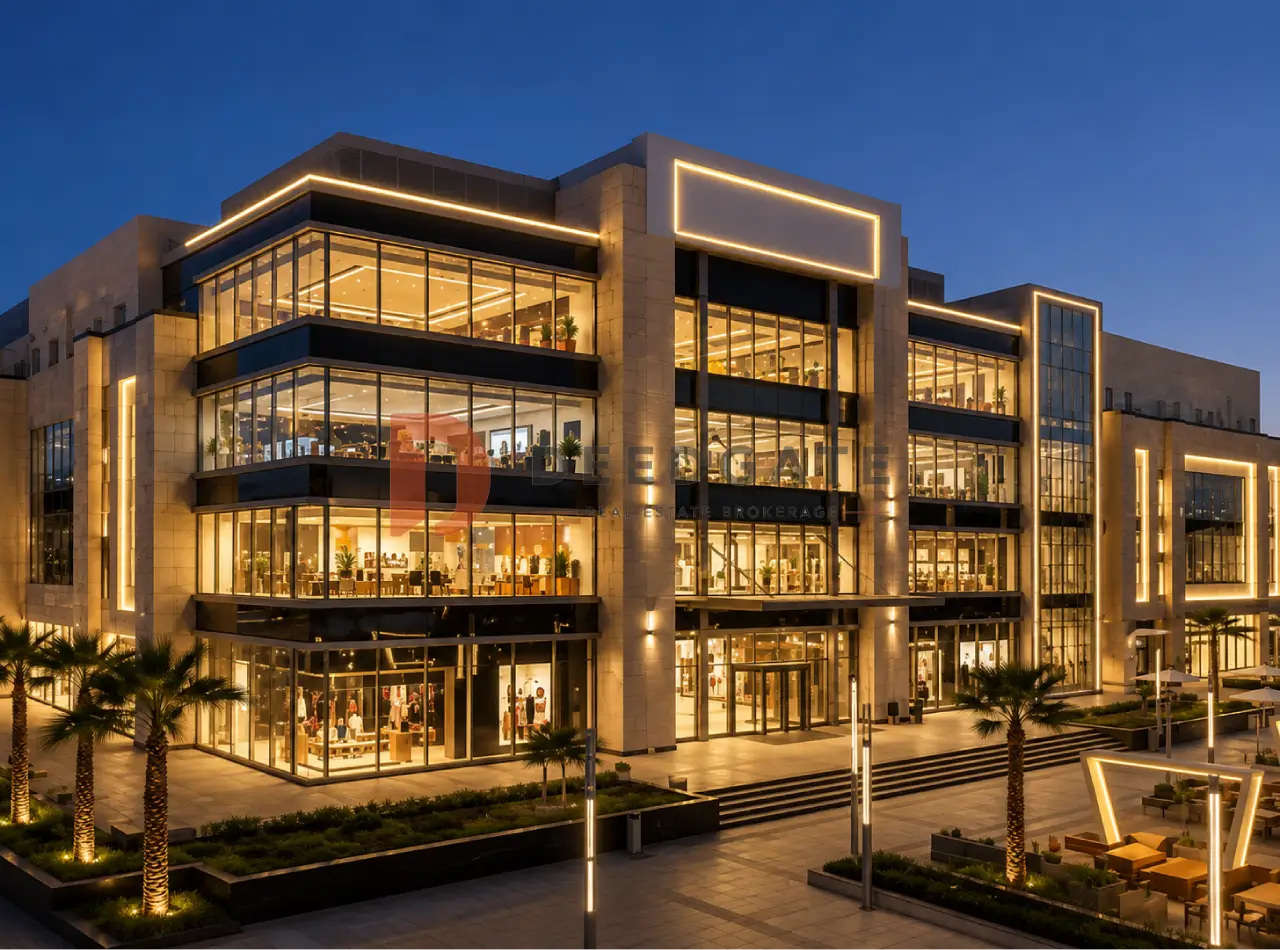
Seventy Plaza Mall New Cairo is a commercial and administrative mall built by Rejan Developments inside the Banks Complex, the cluster of corporate and banking headquarters that sits on North and South 90th Street in New Cairo (Fifth Settlement). The developer placed the building among working head offices rather than among housing, and the Arabic source names Elsewedy, Arab Bank, Nestlé and B.TECH as the occupants of the surrounding plots. That neighbour list is the real asset here, because a retail or office unit in a mall priced at this level lives or dies on weekday footfall from people who already work within walking distance.
The advertised entry ticket of EGP 9,548,000 belongs to one activity only, and every English page currently ranking for this project gets that wrong. It is the price of the smallest administrative office, 62 m² at EGP 154,000 per m², and it is not the entry point for a shop. Anyone shopping for retail space starts EGP 5,852,000 higher on the upper floors and EGP 8,709,000 higher on the ground floor. This page reconciles the developer’s own price table row by row, states which figures close arithmetically and which do not, and lists exactly which attributes the source leaves blank for each unit type.
Where the mall sits inside the Banks Complex
The Banks Complex is a defined commercial and administrative pocket of the Fifth Settlement that grew around the stretch where North 90th Street meets South 90th Street, and it functions as New Cairo’s nearest equivalent to a central business district. Its tenants are banks, telecom offices, corporate headquarters and the service businesses that feed them, which produces a weekday population that arrives in the morning and stays until evening. Rejan Developments sited Seventy Plaza Mall New Cairo directly inside that pocket, in the First Commercial Sector, so the catchment exists before the mall opens rather than depending on a residential phase that has yet to be delivered.
That distinction matters when you compare this mall with the newer retail projects launched on the outer rings of New Cairo. A mall waiting for its surrounding compounds to hand over carries an occupancy risk that a mall inside a built corporate district does not. The trade-off runs the other way on price, because land inside an established commercial cluster costs more and that cost passes straight through to the price per metre.
How far is Seventy Plaza Mall New Cairo from the main landmarks?
Seventy Plaza Mall New Cairo publishes travel times rather than measured distances. The developer’s own figures put the Air Force Hospital at roughly three minutes and the American University in Cairo at roughly six minutes by car, and place the mall a short drive from the Ring Road link toward Maadi. No figure anywhere in the source is given in kilometres.
Two of the published times do not survive a map check, and a buyer should know which ones. The source lists Downtown Mall and Cairo Festival City Mall as one minute away on foot, but both sit on South 90th Street toward the Ring Road interchange, several kilometres from the First Commercial Sector. One minute of walking covers roughly eighty metres, so that claim describes a different location entirely. The published two minute figure for the Ring Road turn toward Maadi has the same problem, since covering that stretch in two minutes would require a speed no city street permits.
What is verifiable is the immediate address. The mall faces Arab Bank and stands beside the B.TECH showroom, with Elsewedy and Nestlé offices in the same cluster. Those are fixed corporate addresses that anyone can check before signing, and they carry more weight for a commercial buyer than a drive time nobody can audit. Treat the published minutes as marketing and measure the route yourself at the hour your business actually trades.
What does the EGP 9,548,000 starting price actually buy?
The EGP 9,548,000 headline at Seventy Plaza Mall New Cairo buys the smallest administrative office in the building, 62 m² on the second floor of the First Commercial Sector, which works out at EGP 154,000 per m² on the instalment plan. It is the administrative row’s minimum ticket and it applies to no other activity in the mall.
Running the headline against every published rate shows why the figure cannot be reused across the price list. Divided by the ground floor retail average of EGP 289,000 per m² it returns 33.04 m², divided by the upper floor retail average of EGP 220,000 per m² it returns 43.40 m², and divided by the administrative average of EGP 162,000 per m² it returns 58.94 m². None of those three areas appears anywhere in the table, whose smallest published area of any kind is 62 m². The headline only resolves cleanly when you divide it by an area rather than a rate, and the rate it implies, EGP 154,000 per m², is never printed on the page.
Set against the headline, the true entry ticket for each activity separates sharply. An upper floor shop starts at EGP 15,400,000, which is 61.3% above the advertised figure. A ground floor shop starts at EGP 18,257,000, which is 91.2% above it. Restaurant and café units carry no published entry price at all, and medical units carry no published price, rate, area or floor.
One detail catches buyers who skim the table. The figure 62 m² appears twice, once as the smallest administrative office and once as the smallest ground floor shop, and the two carry tickets 91.2% apart. Reading the headline price beside the retail row’s minimum area produces a number that is wrong by almost double, which is precisely the error that has propagated across the portals covering this project.
Unit types, areas and floors
Rejan Developments publishes three priced bands for Seventy Plaza Mall New Cairo, split by activity and by floor. The table below reproduces the developer’s figures with their original column labels intact, because the labels change what the numbers mean. Prices were last updated in June 2026.
| Unit type | Floor | Area (m²) | Instalment price (EGP) | Outdoor area | Average instalment rate (EGP/m²) |
|---|---|---|---|---|---|
| Retail shop | Ground | 62 to 686 | 18,257,000 to 175,311,000 | 22 to 35 m² | 289,000 |
| Retail shop | Upper | 70 to 125 | 15,400,000 to 27,500,000 | None published | 220,000 |
| Administrative office | Not stated in the table | 62 to 113 | 9,548,000 to 19,210,000 | None published | 162,000 |
| Restaurant or café | Not published | Not published | Not published | 35 m² terrace cited in prose | Not published |
| Medical unit | Not published | Not published | Not published | Not published | Not published |
Ground floor shops run from 62 m² to 686 m² and add a private outdoor area of 22 m² to 35 m², which is what makes them the premium band. A shop on the ground floor sells its position on the visitor’s path, so the developer charges for frontage rather than for interior volume. The 686 m² ceiling is unusually large for a mall of this kind and suggests the ground floor was laid out to accommodate an anchor tenant alongside the smaller shops.
Upper floor shops run from 70 m² to 125 m² with no outdoor area, and this band is the only one in the table that prices perfectly flat. Every ticket in it works out at exactly EGP 220,000 per m², at the 70 m² floor and at the 125 m² ceiling alike, which means position within the upper floors carries no premium in the published list. The source does not say which upper floors are involved, only that they sit above ground level, so the floor assignment for this band is missing.
Administrative offices run from 62 m² to 113 m² and are the cheapest way into the building. The table leaves the floor column blank for this band, but the developer’s written description supplies it: the offices sit on the second floor of the First Commercial Sector, surrounded by the Banks Complex and the mall’s own food and beverage units. The rate rises across the band rather than staying flat, from EGP 154,000 per m² at the 62 m² entry to EGP 170,000 per m² at the 113 m² ceiling.
Restaurant and café space is described but not priced. The written unit list mentions 48 m² units paired with a 35 m² private terrace, a configuration built for outdoor seating, yet the price table contains no restaurant row. A single ceiling figure of EGP 26,133,000 circulates in the project’s own prose for restaurant units, and it cannot be produced from any published rate multiplied by any published area. Divided by the three published rates it returns 90.43 m², 118.79 m² and 161.31 m², and divided by the 48 m² unit it implies EGP 544,438 per m², nearly double the dearest rate in the table.
Read More: The Node New Cairo
Medical units are the largest gap. They are asserted once, in the source’s own questions section, and nowhere else. The mall carries no medical price, no medical rate, no minimum or maximum medical area and no medical floor assignment, and deedgate’s Arabic profile for Rejan Developments describes Seventy Plaza as a commercial and administrative project with no medical component at all. Until the developer publishes a medical row, treat medical space here as unconfirmed.
Two smaller areas also appear in prose without ever reaching the table. The written description offers commercial units from 34 m² and shops from 40 m² facing the central plaza and the lift core, but the smallest area the price table publishes for any activity is 62 m². Where a project’s prose and its price table disagree, the table is the document a contract is written from, so ask for the 34 m² and 40 m² units in writing with a price attached before treating them as available.
Reading the price basis literally
Every number in the Seventy Plaza Mall New Cairo price table is an instalment price, not a cash price. The developer labels the money column as the instalment price and the rate column as the average instalment rate per metre, and those two words change the entire reading. A cash purchase is explicitly discounted, which means the cash price for every unit in the mall is lower than the figure advertised, and the developer has not published by how much.
The rate column is an average and must not be used as a floor. On the administrative band the published average of EGP 162,000 per m² applied to the 62 m² entry unit returns EGP 10,044,000, which overstates the real entry ticket of EGP 9,548,000 by 5.19%. The average is honest arithmetic, being the exact midpoint of the band’s EGP 154,000 and EGP 170,000 endpoints, but a buyer who budgets from it will misprice the cheapest unit in the building.
The ground floor retail rate does not reconcile with its own row on any test, and it is the one figure on this page worth discarding. Applied to the band’s 62 m² minimum, the published EGP 289,000 per m² returns EGP 17,918,000 against a stated minimum ticket of EGP 18,257,000, falling 1.86% short. Applied to the 686 m² maximum it returns EGP 198,254,000 against a stated maximum of EGP 175,311,000, overshooting by 13.09%. It is not the midpoint of its own endpoints either, sitting 5.09% above the EGP 275,012 that midpoint would produce, so it is neither a floor, nor a ceiling, nor an average of the row it sits in.
Three further points close the price picture. The developer confirms discounts for cash settlement and for a larger down payment but publishes no percentage for either, so every figure quoted here is a zero discount list price. No maintenance fee appears anywhere in the source, and a maintenance charge on a commercial mall is normally levied on top of the unit price rather than inside it, so ask for that percentage in writing. A discount on the down payment also reduces nothing but the down payment, and it should never be read as reducing the balance.
Payment plans and what each one costs per month
Rejan Developments publishes an interest-free schedule with two down payment levels and two terms, which produces four combinations. The stated terms are:
- A reservation down payment of 25% or 30% of the unit price.
- The balance installed over 4 or 5 years with no interest applied.
- Discounts offered against cash settlement or a higher down payment, with no percentage published.
- A stated handover year of 2025.
Because the schedule carries no interest, the total paid is identical under all four plans and the only things that change are the size of the cheque at signing and the size of the monthly instalment. On the EGP 9,548,000 administrative entry unit, a 25% down payment of EGP 2,387,000 leaves a balance of EGP 7,161,000, which costs EGP 149,188 a month over four years or EGP 119,350 a month over five. A 30% down payment of EGP 2,864,400 leaves EGP 6,683,600, costing EGP 139,242 a month over four years or EGP 111,393 over five.
Laid out that way, one of the four plans is strictly dominated. The 30% down payment over four years demands EGP 477,400 more at signing than the 25% down payment over five years and still costs EGP 19,892 more every month, so it loses on both axes at once against a plan the same developer offers. It is also beaten by the 30% down payment over five years, which asks for the identical cheque at signing and EGP 27,848 less per month. Nothing in the published terms rescues it, because the total is the same in every case.
The single caveat is the discount the developer attaches to a higher down payment without quantifying it. If that discount is large enough it could make the 30% route worth taking, but the percentage is not published, so the arithmetic cannot be completed from the page. Ask for the higher down payment discount as a number before choosing between the two levels, and if the answer is vague, the 25% down payment over five years is the plan that wins on the published evidence.
The same pattern scales to the retail bands. An upper floor shop at EGP 15,400,000 runs EGP 192,500 a month on 25% down over five years, and a ground floor shop at EGP 18,257,000 runs EGP 228,212 a month on the same terms. Against the five year to seven year schedules that several neighbouring New Cairo malls advertise, a four or five year term concentrates the cash requirement, so this project asks for stronger liquidity than its entry price alone suggests.
Construction progress and the handover date
Rejan Developments reports Seventy Plaza Mall New Cairo at 80% construction completion, which is the strongest risk argument the project has. A buyer at that stage inspects the actual slab, the actual ceiling height and the actual position of the unit on the floor plate before signing, rather than buying a drawing. Structural risk and specification risk both drop sharply once a commercial building is that far along.
The handover date needs a harder look. The published delivery year is 2025 and the source still describes it as an upcoming handover, yet the same page carries prices updated in June 2026. A delivery year that has already passed while the price list moves forward means the schedule has slipped without a revised date being published, and the source attaches no as-of date to the 80% figure either. Get the current handover date and the current completion percentage confirmed in writing, along with the delay penalty clause, before any deposit changes hands.
The finishing standard is also absent. The source describes flexible internal partitioning that each tenant can reconfigure and says the units are fitted with communications and technical infrastructure, but it never states whether units are delivered core and shell, semi-finished or fully finished. On a commercial unit that distinction can swing the fit-out budget by a substantial share of the purchase price, so it belongs in the contract rather than in an assumption.
Design and building services
The building carries a double facade onto two main axes, which gives ground floor shops two display frontages instead of one and doubles their visibility to passing traffic. Internally the layout turns on a central plaza that serves every floor, with lifts distributed so that upper floor units stay reachable without a detour. That arrangement matters most to the upper retail band, whose value depends almost entirely on how easily a visitor reaches it.
The operating package is specified in more detail than the construction is. The published services are:
- Central air conditioning with smart temperature control and fresh air distribution across the whole mall.
- Security and surveillance using modern cameras, a round the clock security team and electronic access control on entry and exit.
- A multi-storey garage with smart parking management, a valet service and automated guidance to available bays.
- A lift network positioned to connect the floors and carry visitors to the upper units.
- Fire safety systems with emergency exits and early warning alarms built to international standards.
- Maintenance and cleaning through a technical team on duty around the clock and a continuous programme for common areas and facades.
- Smart LED lighting specified as energy efficient across the building.
Facility management is promised but not attributed. The source says the mall is run by a team specialised in commercial facility management and names no company, which leaves the most important operating commitment in the project unverifiable. On a commercial mall the operator determines tenant mix, opening hours, common area standards and ultimately occupancy, so an unnamed operator is a genuine gap rather than a detail. One portal states that Rejan Developments manages the mall itself, but the developer’s own material does not say so, and a broker’s claim is not a management contract.
Several structural figures are missing outright. The source publishes no plot area, no built-up area and no total project area, and the area field on the project record is empty. It also never states how many floors the building has or how many units it contains, even though the price table distinguishes ground from upper and the written description places offices on the second floor. A mall whose total size is unpublished cannot be compared on a rate per metre basis against its neighbours, so that number is worth requesting directly.
Rejan Developments as a developer
Rejan Developments is an Egyptian developer focused on commercial, administrative and medical projects in New Cairo, operating from a head office in EPIC Mall on North 90th Street opposite Waterway 2. The company states more than ten years in the Egyptian market and describes a path that began in South Cairo before concentrating on New Cairo. No founding year is published in any of the company’s own material, so the decade figure is the only tenure measure available.
The portfolio claim attached to this project is large and deserves scrutiny. The project page credits Rejan Developments with Seen Mall and Seen Gardenia Mall in the Fifth Settlement, plus 30 projects in Beit Al Watan, 25 in New Narges, 10 in North Rehab, 10 in South Cairo and 3 each in Andalus and Lotus, which totals roughly 81 developments. The company’s own site supports the general scale and the district list, and the repeated delivery inside one city is the part that carries real weight, because a developer who has built dozens of times in the same district knows its contractors, its suppliers and its permitting.
Two deedgate records disagree on the detail, and the disagreement is worth flagging rather than smoothing over. The developer profile on this site lists only three projects for Rejan Developments, names the first of them Seen Social District Mall rather than Seen Mall, and describes that project as commercial, administrative and medical. The project page names no medical component for Seventy Plaza while the profile’s portfolio is medical-heavy. A leadership name is quoted on the project page but the company’s own website and the property portals give a different surname for the same chairman, so this page omits the name rather than pick a side.
Does the project publish a rental yield or a guaranteed return?
Seventy Plaza Mall New Cairo publishes no rental yield, no return on investment percentage, no payback period and no guaranteed return of any kind. The developer’s material argues that the location supports rental value and occupancy, but it attaches no rent per metre, no expected annual income and no term to that argument anywhere.
That absence is worth stating plainly rather than filling in. A yield is a fraction, and without a stated annual rent the numerator does not exist, so any percentage quoted to you about this mall by a broker has been constructed rather than published. The honest position is that the project’s return is currently uncomputable from public information, and a buyer should build their own estimate from asking rents on comparable units inside the Banks Complex.
If anyone offers you a guaranteed return here, treat it as a claim to be documented before it is believed. A guarantee is only a guarantee when four things are written into the contract: the percentage, the party guaranteeing it, the number of years it runs, and the clause number where it appears. The source for this project supplies none of those four, so no guaranteed return should be assumed to exist, whatever a listing page or a sales call asserts.
Who the mall suits and who it does not
The buyer this project fits is the one who wants a near-finished commercial or administrative asset in a working business district and can fund it quickly. The location inside the Banks Complex delivers an existing weekday catchment rather than a projected one, the 80% completion lets the unit be inspected before contract, and the administrative band at EGP 9,548,000 is a comparatively modest entry point for an office in a district of this profile. Those three facts work together, and they are the strongest part of the case.
The buyer this project does not fit is the one optimising for the longest possible schedule or the cheapest possible entry. A four or five year term is short by current New Cairo standards, and the monthly instalment on even the cheapest unit runs above EGP 111,000 on the most generous plan, which is a serious liquidity requirement. Retail buyers in particular should note that their real entry ticket is 61.3% to 91.2% above the advertised headline, which changes the budget conversation entirely.
Weigh the gaps alongside the strengths before committing. The handover year has lapsed without a published replacement, the finishing standard is undeclared, the operator is unnamed, the total built area is unpublished, restaurant and medical units are described without prices, and the ground floor retail rate does not reconcile with its own row. None of these is disqualifying on its own, but together they mean the contract has to carry the answers that the marketing does not.
This analysis is guidance based on the figures the developer has published and is not investment advice.
Questions buyers ask before signing
What are the unit sizes at Seventy Plaza Mall?
Seventy Plaza Mall New Cairo publishes priced areas from 62 m² to 686 m². Ground floor shops run 62 m² to 686 m² plus a 22 m² to 35 m² outdoor area, upper floor shops run 70 m² to 125 m², and administrative offices run 62 m² to 113 m². Smaller 34 m² and 40 m² units appear in the description but carry no price.
When does Seventy Plaza Mall deliver?
Seventy Plaza Mall New Cairo carries a published handover year of 2025 and a reported construction completion of 80%. That date has now passed while the price list was updated to June 2026, and no revised handover date has been published, so the current delivery date and any delay penalty should be confirmed in the contract.
Are there medical units in Seventy Plaza Mall?
Seventy Plaza Mall New Cairo is sold as a commercial and administrative mall, and medical units are mentioned once without a single supporting figure. No medical price, rate, minimum area, maximum area or floor assignment is published, and the developer’s own profile describes this project as commercial and administrative only, so medical space remains unconfirmed.
What is the down payment at Seventy Plaza Mall?
Seventy Plaza Mall New Cairo offers a reservation down payment of 25% or 30%, with the balance installed interest-free over four or five years. On the EGP 9,548,000 entry office that is EGP 2,387,000 or EGP 2,864,400 at signing. Discounts are offered for cash or a higher down payment, but no percentage is published.
Read More: Mall Golden Gate Fifth Settlement, New Cairo
Who is the developer of Seventy Plaza Mall?
Seventy Plaza Mall New Cairo is developed by Rejan Developments, an Egyptian company with more than ten years in the market and a head office on North 90th Street in New Cairo. Its New Cairo portfolio includes Seen Gardenia Mall and dozens of smaller developments across Beit Al Watan, New Narges, North Rehab, Andalus and Lotus.
Read More: Aisle 90 Fifth Settlement, Mall New Cairo
The short version
Seventy Plaza Mall New Cairo offers a near-complete commercial and administrative asset inside the Banks Complex, with priced units from 62 m², an interest-free schedule over four or five years, and an entry ticket of EGP 9,548,000 that belongs to the administrative band rather than to retail. The location and the 80% completion are the real strengths. The lapsed handover year, the undeclared finishing standard and the unnamed operator are the questions to settle in writing.
To check the current price list, the revised handover date or availability in a specific band at Seventy Plaza Mall New Cairo, get in touch through the form on this page.