
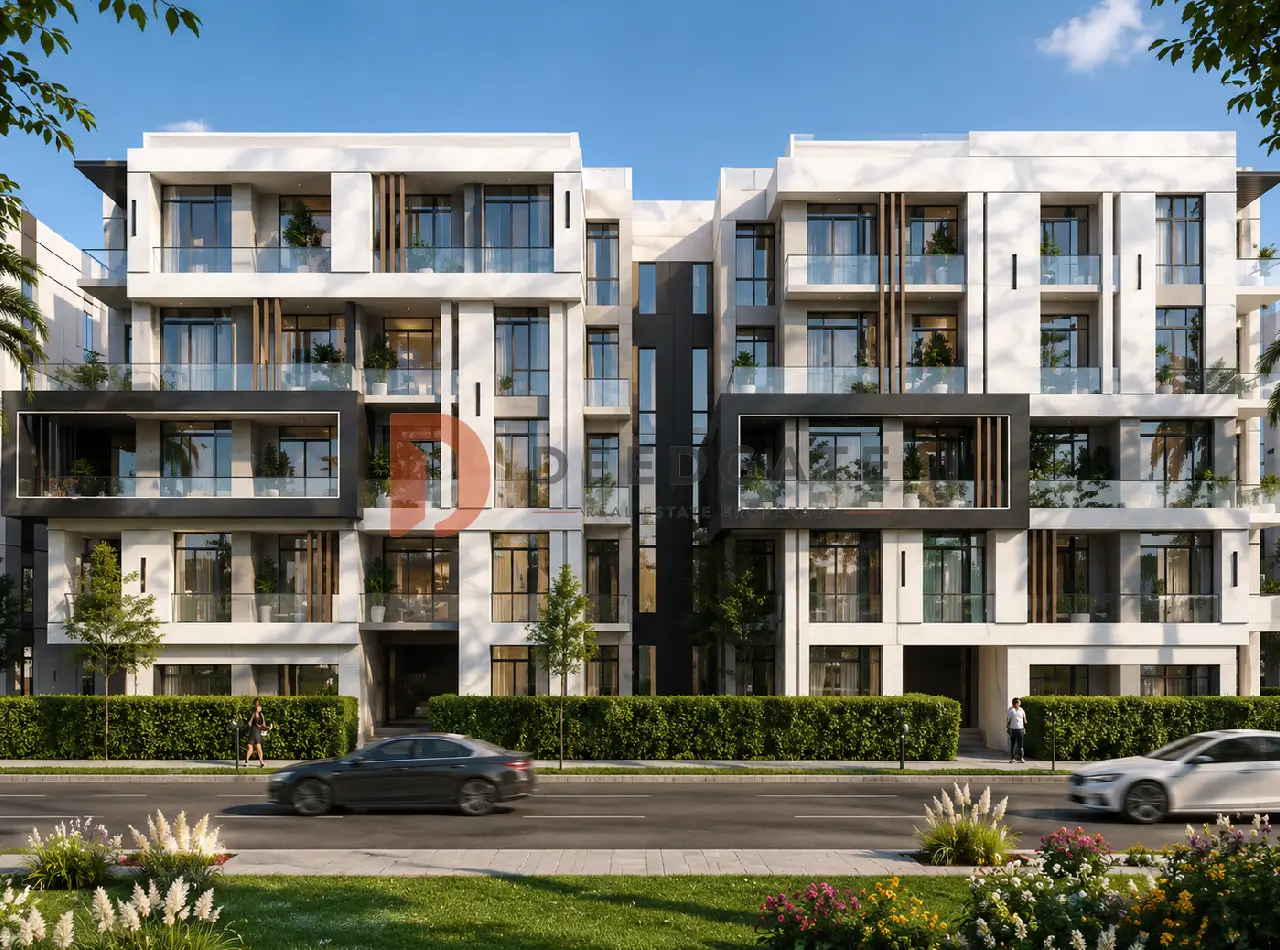
Seven Residence October Gardens is a 52 acre residential compound developed by Harby Group Real Estate Development directly on Zewail Street in October Gardens, West Cairo. The compound faces Zewail City of Science and Technology and the Magdi Yacoub Heart Centre, which gives it an address anchored to two national institutions rather than to an interior residential street. Apartment prices start from EGP 4,231,000 with a 10% down payment and instalments running up to 9 years, and the master plan divides the land into seven independent functional zones instead of clustering every service in a single central spine.
That seven zone structure is the reason the project carries its name, and it is also the attribute that separates it from the standard October Gardens compound layout. Buyers looking at the compound are typically small and mid sized families who want a practical apartment between 109 and 178 square metres with a full service package inside the gates, plus medium term investors entering at launch pricing before handover. This page covers the developer, the exact location data, the unit mix, the 2026 price list, the payment structure, the amenity set, and how the compound sits against its direct neighbours in the same district.
Harby Group: the developer behind the project
Harby Group Real Estate Development is a Cairo and Dubai based property and construction group with more than 15 years of operating history. The group presents itself as a diversified holding rather than a single purpose developer, and its published portfolio covers more than 50 residential, governmental and national projects with a stated cumulative investment value of around EGP 15 billion. That profile matters when you assess a compound that will take several years to complete, because the risk in an off plan purchase sits with the developer’s ability to build, not with the brochure.
The group operates through four specialised companies that each cover a different part of the delivery chain. The Grove manages luxury hotel operations. MGH handles contracting and infrastructure and has executed more than 150 kilometres of main roads. Jenin is a first class contracting company that has delivered 21 government projects. Value Gate Leasing is the Dubai based investment arm, carrying investments of around AED 70 million.
The practical consequence of that structure is that Harby Group builds with in house execution arms rather than outsourcing construction entirely to third party contractors. A developer that owns its own contracting and infrastructure companies controls its own schedule to a far greater degree, which measurably reduces the delay risk that dominates off plan purchases in the Egyptian market. It also means the group has direct experience with road and utility works, which is relevant in October Gardens, where infrastructure delivery is still catching up with the pace of new launches.
Harby Group has already built in this exact district. The group executed Masar Strip Mall in October Gardens, a delivered commercial project in the same submarket as Seven Residence October Gardens. For a buyer, a completed project by the same developer in the same neighbourhood is an unusually useful reference point, because the finishing quality, the facade materials and the maintenance standard can be inspected in person before signing. That option does not exist with a developer launching its first project in the area.
Construction on the compound formally began after the project secured its ministerial approvals, and the developer adopted a payment model that ties customer instalments to construction progress. Announcing works after approvals rather than before them is a meaningful sequencing signal in a market where several launches have preceded their permits. The developer’s public positioning for the project runs under the line “life is simpler than that”, which it translates into a low built up ratio and a heavy allocation of land to open space.
Where is Seven Residence October Gardens located?
Seven Residence October Gardens sits directly on Zewail Street, also known as the Ahmed Zewail Axis, inside October Gardens in West Cairo, facing Zewail City of Science and Technology and the Magdi Yacoub Heart Centre. The compound is 3 minutes from the Ring Road and 7 minutes from Mall of Egypt, and it connects onward through Al Wahat Road and the Middle Ring Road. Its frontage on a named arterial road, rather than an internal street, is the defining feature of the address.
The distinction between a compound on a main axis and a compound buried in an internal grid is not cosmetic. Direct frontage shortens the daily drive to the Ring Road, removes the internal loop that many October Gardens projects require before reaching a main road, and gives the compound’s retail strip visible street exposure. Visible retail is what turns a commercial strip inside a compound into a functioning one, because it draws footfall from the surrounding district rather than depending only on residents.
The two institutions across the street shape the character of the immediate surroundings. Zewail City of Science and Technology is Egypt’s flagship research university, and the Magdi Yacoub Heart Centre is a specialised cardiac facility with national referral status. Together they generate a steady population of academics, researchers, medical staff, students and visiting families in the immediate radius. That is a rental demand profile most residential compounds in October Gardens do not have next door.
Distances and landmarks from Seven Residence October Gardens
- Ring Road: 3 minutes, the primary connector to the rest of Greater Cairo.
- Mall of Egypt: 7 minutes, the largest retail and entertainment destination in the West Cairo catchment.
- Zewail City of Science and Technology: directly opposite the compound entrance.
- Magdi Yacoub Heart Centre: directly opposite, on the same Zewail Street frontage.
- Grand Egyptian Museum and the Pyramids plateau: minutes away via Al Wahat Road.
- 26th of July Axis and Gamal Abdel Nasser Axis: direct links toward Sheikh Zayed and 6th of October City.
- Fayoum Road and Al Wahat Road: the southern and western corridors out of the district.
- Pyramids City 5 and Aqmar October: neighbouring compounds that anchor the surrounding residential fabric.
The road network around the compound reaches further than the immediate district. The 26th of July Axis and the Gamal Abdel Nasser Axis carry traffic toward Sheikh Zayed and central 6th of October City, while Fayoum Road and Al Wahat Road handle the southern and western movements. Those four corridors, combined with the Ring Road entry three minutes away, mean a resident is not dependent on a single route during peak hours, which is a practical resilience factor rather than a marketing claim.
The opening of the Grand Egyptian Museum near the district added a tourism layer to an area that was previously purely residential and educational. Museum traffic feeds the Al Wahat Road corridor and the Pyramids approach, which has accelerated road upgrades and service openings around Zewail Street. For an owner considering short term rental, proximity to a major international attraction widens the tenant pool beyond the usual long term family lease.
The seven zone master plan explained
The compound divides its 52 acres into seven independent functional zones, and this division is the architectural idea the entire master plan is built around. The developer assigned a dedicated sports zone, a meditation and yoga zone, a children’s play zone, a co-working area, an open air amphitheatre, a social club, and a commercial zone. Each daily need has its own defined location inside the walls instead of competing for space in one central clubhouse.
Read More: Compound Badya Palm Hills 6 October
The functional benefit of that separation is congestion control. When a compound places its gym, its pool, its children’s area and its cafes in one building or one plaza, that node becomes crowded at exactly the hours everyone wants to use it, and the noise from the active uses reaches the quiet ones. The compound distributes those uses geographically, so the yoga and meditation zone is not adjacent to the amphitheatre, and the children’s play area is not sharing a boundary with the co-working space.
The second consequence is that buyers can position themselves. A young household that uses the gym and the social club daily can choose a building near the sports zone, while a family that values quiet can select a unit near the green and meditation areas. In a single node compound that choice does not exist, because every unit has the same relationship to the same central cluster. Choosing your relationship to the amenity map at purchase is a real differentiator at this price tier.
Architecturally, the buildings use a contemporary, restrained facade language with a double height entrance treatment and materials selected to reflect natural light. Interior layouts prioritise cross ventilation and daylight in every unit, which is achievable precisely because the buildings are spaced apart rather than packed. Fountains and artificial lakes are distributed as water features across the site rather than concentrated in a single ornamental lagoon at the entrance.
What does a 70% open space ratio actually mean?
The compound allocates 70% of its 52 acres to open and green space, with the developer’s announced built up footprint at roughly a quarter of the land. In practice that means buildings occupy about a third of the site at most, so blocks sit further apart, sight lines between windows lengthen, and the visual density that makes a compound feel crowded drops sharply. The ratio is a measurable design decision, not a descriptive adjective.
Three concrete outcomes follow from that ratio. Most units get a green view rather than a facing wall, because there is more landscape than building to look at. Natural ventilation and daylight improve, because spacing between blocks lets air move and light reach lower floors. And resale value holds better over time, because generous green space is one of the most durable value supports in Egyptian compound pricing, unlike finishing fashions or amenity gimmicks that date quickly.
The distribution matters as much as the percentage. Because the landscape is spread across the seven zones instead of pooled at one end of the site, the green benefit reaches units across the whole master plan rather than only the premium blocks facing a central park. That is the difference between a green ratio that is real for every buyer and a green ratio that is real only for the units the developer prices highest.
Unit types and sizes at Seven Residence October Gardens
Seven Residence October Gardens offers apartments only, in three bedroom count categories that span 109 to 178 square metres. Two bedroom apartments start from 109 square metres and represent the entry point into the compound, aimed at newly married couples and small families who want a practical footprint without stretching the budget. Three bedroom apartments start from 141 square metres and give mid sized families a second living zone. Four bedroom apartments start from 178 square metres with the widest interior distribution in the project.
Read More: Compound Jiran Residence October Gardens
| Unit type | Bedrooms | Area (m²) | Instalment price (EGP) | Average price per m² (EGP) |
|---|---|---|---|---|
| Apartment | 2 bedrooms | 109 to 125 | 4,231,000 to 4,708,000 | 37,000 |
| Apartment | 3 bedrooms | 141 to 175 | 5,121,000 to 6,964,000 | 37,500 |
| Apartment | 4 bedrooms | 178 | 7,137,000 | 40,000 |
Sizes step up gradually inside each category rather than jumping between them. Two bedroom units range from 109 to 125 square metres, and three bedroom units range from 141 to 175 square metres, so a buyer can trade a wider living room against a larger second bedroom without moving into a higher price bracket. That internal gradient is what lets a household match the layout to how it actually lives instead of accepting the only plan available at its budget.
The decision to build apartments exclusively, with no villas, townhouses or twin houses, defines the compound’s social profile. A single unit typology produces a homogeneous resident base in terms of budget and household size, which keeps service charges predictable and avoids the two tier dynamic that appears in mixed compounds where villa owners and apartment owners have different expectations of the facilities. It also concentrates the developer’s construction effort on one repeatable building type, which supports schedule discipline.
The 109 to 178 square metre band covers a family through more than one stage of its life. A couple can enter at 109 square metres, and a family that grows can move up inside the same compound rather than leaving it, which is the practical argument for holding a unit here long term. For investors, the same band matches the most liquid resale segment in West Cairo, because mid sized apartments have the deepest buyer pool when it is time to exit.
Apartment prices in 2026 and the price per metre
Apartment prices at Seven Residence October Gardens start from EGP 4,231,000 for the smallest units, with an average price per metre beginning at EGP 37,000 during the launch phase and reaching EGP 40,000 for four bedroom apartments. Prices are updated for 2026 and are subject to revision as sales phases progress, which is standard practice for a compound still in construction. The full list runs from EGP 4,231,000 to EGP 7,137,000 across the three categories.
The price per metre gradient tells you how the developer values the product. Two bedroom units carry the lowest metre rate at EGP 37,000, three bedroom units sit at EGP 37,500, and four bedroom units are priced at EGP 40,000 per metre. The premium on the largest category reflects both scarcity of the 178 square metre plan and the fact that larger apartments generally occupy better positioned corners within a block.
Placed against the district, that entry price puts the compound in the middle of the October Gardens range rather than at either extreme. Neighbouring compounds in the same submarket open between roughly EGP 3.4 million and EGP 5.5 million depending on the developer and the finishing standard, so an entry at EGP 4,231,000 is neither the cheapest ticket in the district nor a premium outlier. That middle position is the one that historically leaves the most headroom, because the unit is not already priced at the ceiling of its own market.
The payment plan and booking terms
The developer set the down payment at 10% of the total unit value, with the balance spread over 9 years without interest. A reservation deposit of EGP 50,000 is required to hold a unit and is fully refundable, and the developer offers a cash discount reaching 35% for a buyer who settles the full value upfront. The combination of a low entry payment and a long instalment horizon is the core commercial argument of the launch.
- Down payment: from 10% of the total unit price.
- Instalment period: up to 9 years, interest free.
- Reservation deposit: EGP 50,000, fully refundable.
- Cash discount: up to 35% for full upfront settlement.
- Price per metre: from EGP 37,000 up to EGP 40,000 depending on the unit category.
- Instalment structure: customer payments tied to construction progress.
A 10% down payment on the entry unit means roughly EGP 423,100 to hold a 109 square metre apartment, which is a materially lower barrier than the 15% to 20% many West Cairo compounds now require. Spreading the balance across 9 years without interest keeps the monthly commitment inside the range a dual income household can carry, and it is the reason the compound reaches a wider buyer pool than its headline price alone would suggest.
The 35% cash discount deserves separate consideration because it changes the arithmetic entirely for a liquid buyer. Applied to the entry unit, it brings an EGP 4,231,000 apartment down to roughly EGP 2.75 million, which lands well below the cheapest instalment priced unit in the surrounding compounds. A buyer choosing between instalments and cash should compare that discount against the return they could earn on the same capital elsewhere over the same 9 year window.
Read More: Compound Hom October Gardens
Finishing standard and handover
Units at Seven Residence October Gardens are delivered semi finished, with handover scheduled 3.5 years from the contract date. Press coverage of the construction launch places the expected handover window in 2029. Semi finished delivery means the developer completes the structure, external works, plumbing and electrical rough in, and the owner executes the internal finishing to their own specification and budget.
The financial logic of semi finished delivery is straightforward. It lowers the base unit price against a fully finished equivalent, and it shifts the finishing spend to the handover period rather than folding it into the instalment schedule from day one. An owner therefore pays for the shell over 9 years and funds the interior at the point they actually need it, which improves cash flow across the purchase.
For an investor the same standard offers a different advantage. A landlord targeting the rental pool around Zewail City can execute a practical, durable finishing package calibrated to tenant expectations rather than an expensive designer specification that will not be reflected in the rent. That control over the finishing budget is not available in a fully finished handover, where the developer’s specification is priced into the contract whether it suits the intended use or not.
The 3.5 year timeline confirms the compound is an off plan purchase and not a ready to occupy option. That excludes buyers who need immediate possession, and it favours buyers planning on a medium term horizon who want launch pricing before the project is complete. The developer’s decision to link instalments to construction progress partially aligns the two sides of that timeline, because payments track visible work rather than a calendar alone.
Amenities and services inside the compound
Services are distributed across the seven zones so that a resident finds a complete daily ecosystem without leaving the gates. The set spans recreation, sport, social life, retail and security, supported by landscape and water features covering most of the site. The list below reflects the facilities confirmed by the developer.
- Social club: a combined social, sporting and recreational hub hosting events and activities for all age groups.
- Sports zone: a dedicated athletics area with a fully equipped gym.
- Meditation and yoga zone: a separate quiet space for relaxation and practice, deliberately isolated from the active zones.
- Open air amphitheatre: an outdoor venue for performances and community events.
- Co-working space: equipped workstations inside the compound for residents working remotely.
- Kids area: secured, age segmented play zones for children.
- Commercial zone: a retail strip with shops, brands, restaurants and cafes.
- Water features: fountains and artificial lakes distributed across the master plan.
- Open spaces: walking and jogging tracks plus dedicated cycling lanes.
- Mosque: located within the compound boundaries.
- Covered garages: secured parking that keeps vehicles off the internal roads.
- Integrated security: 24/7 surveillance cameras, electronic gates and on site security personnel.
- Maintenance and property management: a scheduled maintenance team and professional facility management for the common areas.
Two entries on that list are unusual for a mid market October Gardens compound. A dedicated co-working space acknowledges that a significant share of professional work now happens at home, and it gives residents an alternative to converting a bedroom into an office, which directly protects the usable area of a 109 square metre apartment. The meditation and yoga zone is similarly uncommon at this price tier, where wellness provision usually stops at a gym.
The amphitheatre and the social club together give the compound a programmed social calendar rather than a set of static facilities. That distinction affects how a community forms over the first years after handover, particularly in a district where most residents will be arriving from elsewhere in Greater Cairo at roughly the same time. Facilities that host events build a resident network faster than facilities that only host individuals.
On the operational side, covered parking, electronic gates and a professional facility management team address the three complaints that most commonly surface in delivered Egyptian compounds: internal congestion, access control and maintenance decline after the developer hands over the common areas. The presence of a dedicated property management function in the plan is worth confirming in the contract, since service charge terms and management scope are what determine whether these facilities stay in working condition a decade after handover.
October Gardens as a district
October Gardens is the modern urban extension of 6th of October City, planned with wider road reservations and lower density than the older core of the city. That planning difference is why the district has absorbed a wave of new compound launches over recent years while the original 6th of October districts have largely stopped adding large residential land parcels. Buying in October Gardens means buying into an area still forming rather than one already settled.
The Grand Egyptian Museum opening near the district changed its economic weight. A national tourism anchor within minutes of the area brought road investment, service openings and commercial interest that a purely residential suburb would not have attracted on its own, and the effects concentrate along the corridors the compound sits on. Zewail Street specifically has seen its traffic profile and its service density rise alongside that shift.
The timing argument follows from that. A compound entering the market while the district is on its growth curve captures the gap between launch pricing and post handover pricing, whereas a compound entering a mature district is already priced at the district’s ceiling. October Gardens is currently one of the fastest developing residential zones in West Cairo by new project count and infrastructure spend, which is the context that makes launch pricing here meaningful rather than merely cheap.
The counterweight is that a forming district carries forming district problems. Service density around some October Gardens parcels is still thinner than in Sheikh Zayed or central 6th of October, and some internal road links are still under construction. A buyer should weigh the appreciation argument against several years of living in an area that is still completing itself, which is the honest trade in every emerging submarket.
How the compound compares with neighbouring October Gardens projects
Placing the compound against its immediate neighbours is the fastest way to read its real price position. Within the same district, Samaya opens from around EGP 3.45 million, Aqmar October from around EGP 3.79 million, O Nine October from around EGP 4.57 million, West Days from around EGP 4.6 million, and Beta Residence from around EGP 5.46 million. An entry at EGP 4,231,000 places Seven Residence October Gardens in the middle of that spread, below several projects and above others.
Price alone does not explain the positioning. What differentiates this compound from same tier neighbours is the combination of three attributes: direct frontage on Zewail Street opposite Zewail City of Science and Technology, a 70% open and green space allocation, and the seven independent zone master plan. Individually each of those exists elsewhere in October Gardens. Together in one mid tier project they are rare.
Against the cheaper end of the district, the premium buys the address and the green ratio. Against the more expensive end, the saving comes with a longer handover horizon and a semi finished standard rather than a fully finished delivery. A buyer comparing options should price those two variables explicitly, because a fully finished unit at EGP 5.4 million and a semi finished unit at EGP 4.2 million plus finishing cost can converge much more closely than the headline figures suggest.
The neighbouring compounds also determine the district’s future amenity map. Pyramids City 5 and Aqmar October sit close enough that their retail strips and service offerings effectively extend what is available to residents here, which is how a cluster of compounds compensates for a district that has not yet built its standalone commercial infrastructure. Buying inside a cluster is generally safer than buying an isolated parcel with no neighbouring development.
Who is this compound right for?
The compound fits small and mid sized families looking for a practically sized apartment between 109 and 178 square metres with a full service package inside one gated boundary, particularly households connected to the Zewail City academic cluster or the medical facilities on the same street. It also fits medium term investors who prefer entering at launch pricing with a low down payment in order to capture the difference between launch value and post handover value.
It does not fit two buyer profiles. Anyone who needs immediate possession is excluded by the 3.5 year handover, and anyone looking for a villa, townhouse or any form of standalone unit is excluded because the compound builds apartments only. Buyers who want a fully finished unit they can occupy without an interior fit out will also need to budget separately for finishing, which is a real cost that belongs in the comparison from the start.
Being explicit about the mismatch cases is more useful than a general recommendation. A buyer who identifies their own profile in the exclusion list saves the time and the reservation deposit they would otherwise spend discovering it later, and a buyer who identifies themselves in the fit list can move to comparing specific units rather than comparing compounds.
Is Seven Residence October Gardens a good investment?
The investment case for Seven Residence October Gardens rests on three factors that can be measured from the project’s own data rather than from sentiment. The first is the location on Zewail Street opposite Zewail City of Science and Technology and near the Grand Egyptian Museum, an environment that combines resident demand from families and academics with rental demand tied to educational and tourism movement in West Cairo.
The second is the entry point. Buying at launch at EGP 37,000 per metre with a semi finished standard creates a spread between launch pricing and post handover pricing in a district whose price curve is still rising. The fact that the compound’s opening price sits mid range against its neighbours reinforces that spread, because a unit priced at the middle of its own submarket has room to move upward, whereas a unit priced at the top has already consumed its appreciation in advance.
The third is the developer’s execution structure. Owning four operating companies across hotels, contracting, infrastructure and investment reduces completion risk relative to a developer that subcontracts every stage, and the delivered Masar Strip Mall in the same district provides a verifiable execution reference. Ministerial approvals secured before the construction announcement add a further procedural signal in a market where permitting delays are a common source of schedule slippage.
The offsetting factor is the timeline. The compound is under construction with handover 3.5 years from contract, so capital is committed for a multi year period without rental income during that window. For yield specifically, the 109 square metre two bedroom apartments are the strongest candidates, because they sit closest to the student and small family rental segments around Zewail City and carry the lowest capital outlay per unit. This analysis is provided for guidance only and does not constitute investment advice.
What to verify before signing the contract
Four contractual points decide how an off plan purchase here behaves in practice, and none of them appear in a price list. The first is the resale clause. Ask at what stage of the payment schedule the contract permits transferring the unit to another buyer, what administrative fee applies, and whether the developer’s consent is discretionary, because a medium term investor’s exit depends entirely on that clause.
The second is the delay remedy. A 3.5 year handover window should be paired with a written penalty or compensation mechanism if the developer misses it, and the presence of that clause is a stronger indicator of confidence than any marketing statement about schedule. The third is the exact definition of semi finished for this project, since the term covers a wide range in the Egyptian market, from a bare shell with rough in services to plastered walls with screed floors and installed doors. Getting that specification in writing is what lets you budget the finishing cost accurately.
The fourth is the service charge. Ask how the annual maintenance fee is calculated, when it starts, how it can be escalated, and which of the seven zones it covers, because a compound with distributed amenities across a 52 acre site carries a higher operating cost than a single clubhouse layout. Confirming the mechanism now prevents the most common source of dispute between owners and management companies after handover.
Alongside those four, verify the project’s registration status and the unit’s own paperwork against the ministerial approvals the developer announced before starting construction. The developer’s licensing position is public information, and matching the approval covering the parcel to the specific building and unit number in your contract is a routine check that takes one visit and removes the single largest legal risk in an off plan transaction.
Frequently asked questions
When does Seven Residence October Gardens deliver?
Seven Residence October Gardens hands over 3.5 years from the contract date, with press coverage of the construction launch pointing to 2029. Units are delivered semi finished, so the owner completes the interior. The compound is still under construction, which suits a medium term buyer rather than one needing immediate possession.
How much do apartments at Seven Residence October Gardens cost?
Apartments at Seven Residence October Gardens start from EGP 4,231,000 for the smallest units, with an average price per metre from EGP 37,000 rising to EGP 40,000 for four bedroom plans. Prices are updated for 2026 and change across sales phases. A cash discount reaching 35% applies to full upfront payment.
What is the payment plan at Seven Residence October Gardens?
Seven Residence October Gardens requires a 10% down payment with the balance paid over 9 years without interest, plus a fully refundable EGP 50,000 reservation deposit. Instalments are linked to construction progress. The low entry payment combined with the long horizon lowers the barrier compared with competing October Gardens launches.
Who is the developer of Seven Residence October Gardens?
Seven Residence October Gardens is developed by Harby Group Real Estate Development, a Cairo and Dubai group with over 15 years of experience and more than 50 delivered projects. The group operates four specialised companies across hotels, contracting, infrastructure and investment, and previously executed Masar Strip Mall in October Gardens.
How big is Seven Residence October Gardens?
Seven Residence October Gardens spans 52 acres in the heart of October Gardens, with 70% of the land allocated to open and green space. The master plan divides that area into seven independent functional zones covering sport, meditation, children, co-working, an amphitheatre, a social club and retail.
Summary
Seven Residence October Gardens combines a seven zone master plan on 52 acres, a Zewail Street address facing Zewail City of Science and Technology, and a 70% open space allocation, with apartments from EGP 4,231,000 on a 10% down payment and 9 year instalments from Harby Group. That mix targets families and medium term investors who want a mid sized apartment with complete services in a fast growing West Cairo district.
To check updated prices or arrange a viewing of the available units, get in touch through the contact form on this page.