
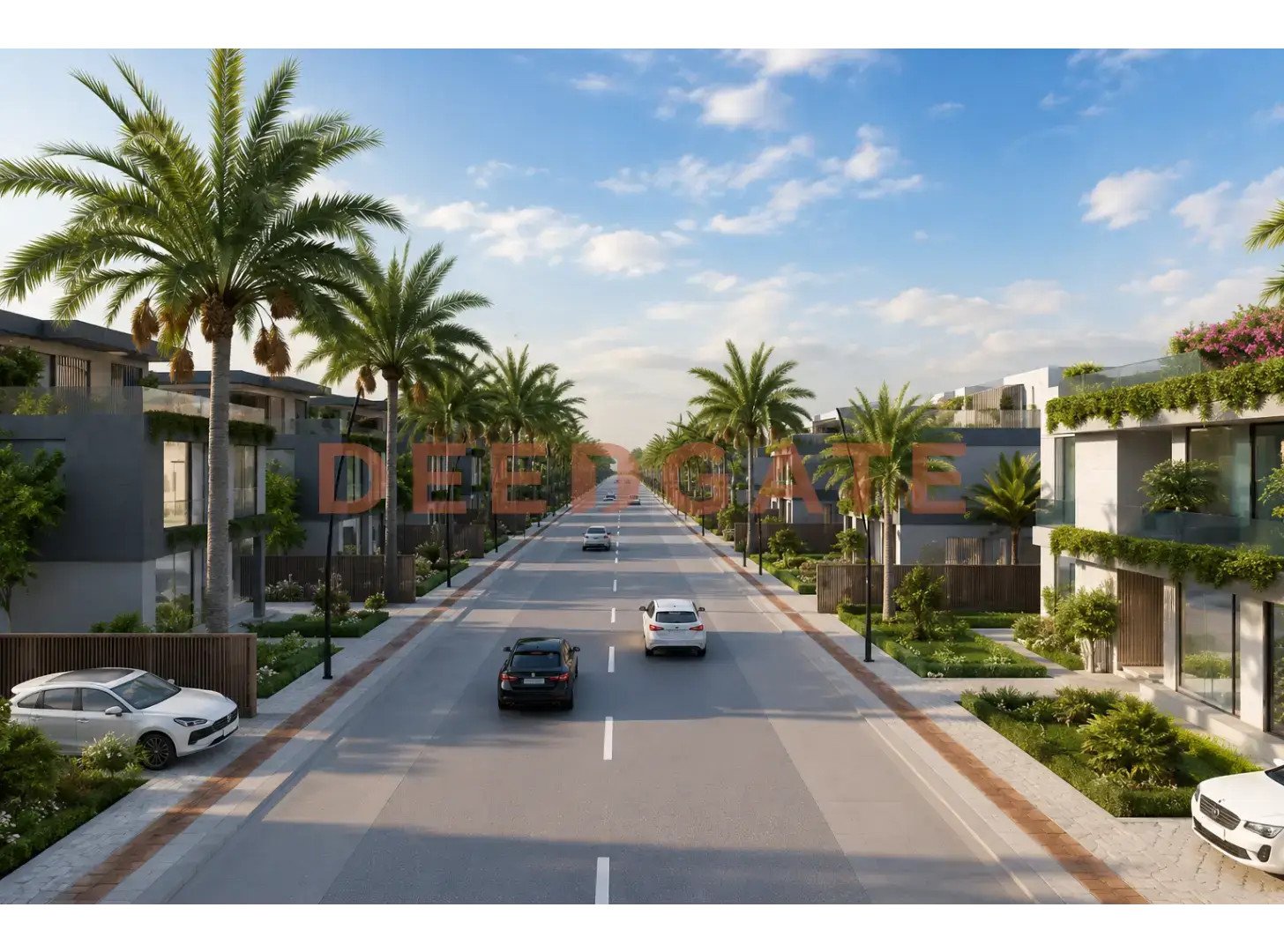
Saada Compound New Cairo is a villas-only gated community that Horizon Egypt Developments built on 371 acres directly on Suez Road in the Fifth Settlement, and it is the Emirati group’s first residential project in the Egyptian market. What sets the project apart from its Fifth Settlement neighbours is its density: the developer kept the built-up footprint to just 12% of the land and handed 88% to green spaces and artificial lakes, spreading townhouses, twin houses and standalone villas thinly across the plot rather than stacking apartments. Unit prices start at 35,000,000 EGP for a townhouse and reach 92,000,000 EGP for the largest standalone villas, with payment plans running up to 7 years and a reservation deposit of 100,000 EGP.
This combination, Gulf-styled villas on a building ratio that most rivals cannot match, places Saada Compound New Cairo in the low-density, high-privacy tier of the market alongside established communities such as Madinaty, Zed East and Al Rehab. The masterplan carries the signature of consultant architect Adnan Saffarini, whose portfolio spans towers and residential complexes across Dubai, and the project sits beside a large mixed-use component, Mall PlusPlus, that adds a commercial spine to what would otherwise be a purely residential address. The sections below cover the location, the developer, the urban design, unit sizes, prices, payment structure, delivery, amenities, the commercial mall, and an evidence-based read on the investment case.
Where exactly is Saada Compound New Cairo located?
The project sits in the Fifth Settlement of New Cairo with a direct frontage on Suez Road, and it connects to the Mohamed Naguib and Gamal Abdel Nasser axes that link the district to the New Administrative Capital and eastern Cairo. The location places residents minutes from the Ring Road and the American University in Cairo, and it neighbours the Madinaty, Al Rehab, El Shorouk and Zed East communities.
Horizon Egypt chose this specific stretch because Suez Road has shifted over recent years from a transit artery into a serviced residential corridor, helped by the Middle Ring Road expansions and its proximity to the New Capital extensions. The same corridor feeds the project onto the Ring Road toward Cairo International Airport, and it keeps the compound within fast reach of the business hubs in the First Settlement and wider New Cairo. For a buyer weighing daily commute against privacy, the address answers both: an arterial road at the gate, and a low-traffic residential envelope inside it.
Landmarks and axes near the project
- Mohamed Naguib Axis: a primary route that ties the Fifth Settlement to the New Administrative Capital and runs alongside the project, making the Capital’s Government District a practical 20 to 25 minute drive.
- Gamal Abdel Nasser Axis: a working axis linking the north and south of New Cairo and connecting onward to the El Mosheer Tantawy Axis and the Middle Ring Road.
- The Ring Road: a short distance from the gate, opening quick routes to Cairo International Airport, Nasr City and downtown Cairo.
- The American University in Cairo (AUC): among the closest residential projects to the AUC campus in the Fifth Settlement, which suits faculty, international students, and the families of children in the feeder international schools.
- Madinaty, Al Rehab and El Shorouk: fully serviced communities developed by Talaat Moustafa Group and by El Shorouk’s developers, whose presence supports resale demand because they serve the same buyer segment.
- Zed East Fifth Settlement: an adjacent project that places Saada within a cluster of comparable, low-density, upper-tier communities.
- Cairo International Airport: reachable on a direct path via the Ring Road, which matters for the multinational residents who travel frequently.
The Fifth Settlement as a district
The Fifth Settlement is the most mature residential district within New Cairo, and it frames the value of any project sitting inside it. Its spine runs along North and South Ninetieth Street, and it holds the highest concentration of international schools, private universities and medical facilities on the east side of Cairo, which is why villa demand there stays resilient across market cycles. Placing a villas-only community on the Suez Road edge of this district gives Saada the district’s services without the density of the older, apartment-heavy quarters closer to Ninetieth Street.
The Suez Road corridor is the newest growth front of the Fifth Settlement, and its trajectory is tied to the New Administrative Capital. As the Capital fills in, the axes that cross this corridor carry more daily traffic between the two cities, which historically lifts land values along the connecting roads. A buyer here is effectively buying into that corridor’s appreciation curve, not only into a single compound, and that district-level context is what separates a location decision from a purely aesthetic one.
The developer: Horizon Egypt Developments
Horizon Egypt Developments is the Egyptian arm of an Emirati real estate group chaired by Sheikh Majid Al Nuaimi, head of the Ajman Royal Court and a former Minister of State for Federal National Council Affairs. Saada is the company’s debut project in Egypt, and for its launch the developer paired with the Adnan Saffarini consultancy office to carry an Emirati luxury building style into the Fifth Settlement. Beyond this compound, the same brand extends across other Saada-labelled projects and the Mall PlusPlus commercial component, giving the group a growing footprint in New Cairo and on the North Coast.
A first project cuts two ways, and an honest buyer assessment should hold both. On one side, the company has no prior delivery record in Egypt to measure against, which is the single most relevant risk for a villa buyer at this price. On the other side, belonging to an Emirati group with a known governmental and financial profile lowers the likelihood of the funding stalls that can hit a newly formed local developer. For units priced above 35,000,000 EGP, where the core risk is the ability to honour the delivery schedule rather than a modest price swing, that backing is a material factor worth weighing.
Architecture and the Adnan Saffarini signature
Horizon Egypt entrusted the design of the compound to consultant architect Adnan Saffarini, one of the Gulf region’s better-known names, whose record includes a number of towers and residential complexes in Dubai. The result is an architectural vocabulary that blends traditional Arabic elements with contemporary lines: tall arches at the gates, Arabic calligraphy carrying the project name, and blue tones drawn from the colour of the Gulf, set against neutral facades and wide glazing inside the villas.
The villas are organised into clusters, and each cluster is centred on an artificial lake ringed by gardens and palm trees. This cluster-and-lake layout breaks up the length of the compound and gives every group of villas its own internal waterfront, a pattern closer to Emirati resorts than to the conventional compounds of New Cairo. Every villa includes a private garden and a standalone pool within its own plot, which removes the need to rely on shared facilities for day-to-day privacy. For families who value seclusion over communal density, that per-plot privacy is the design’s defining promise.
Total area and green-space ratio
The total area of the project reaches 371 acres, roughly 1.56 million m², of which the developer allocated 88% to green spaces and artificial lakes and left no more than 12% for buildings and roads. That green ratio ranks among the highest across New Cairo compounds, where building ratios in most competing projects fall between 18% and 25%, and it translates into lower population density and a wider spread of villas across the ground.
This ratio carries a direct effect on value: a lower resident density lifts the per-villa resale price, and it keeps privacy a measurable feature rather than a marketing word. The bulk of the open area takes the form of lakes, pedestrian walkways and open landscaped zones, planted densely with palm trees and Arabic flowering species. The point is not decoration for its own sake; a compound that commits 88% of its land to open space structurally limits how many neighbours a resident can ever have, which is exactly what the low-density buyer is paying for.
Read against the market, the arithmetic is stark. Where a typical New Cairo compound builds on 18% to 25% of its land, Saada builds on 12%, so on the same acreage it fits fewer homes and gives each one more surrounding open ground. On 371 acres that difference compounds into a materially lower unit count than a conventional compound of the same size would carry, and scarcity of supply is the mechanism that tends to protect villa prices over time. The masterplan reinforces this by distributing the villas as separate clusters rather than continuous rows, so the density a resident actually experiences at their own front door is lower still than the project-wide average implies.
Unit types and villa sizes at the compound
The project offers villas only, with no apartments or duplexes, which separates it from the majority of Fifth Settlement projects that mix unit types. The villas divide into three categories, townhouse, twin house and standalone, with built areas graduating from 199 m² up to 776 m². The table below sets out each type against its size range and character.
Read More: Compound Home Fifth Settlement, Residence New Cairo
| Unit type | Area (m²) | Description |
|---|---|---|
| Townhouse | 199 to 300 | Corner and middle units within a row of three or more villas |
| Twin house | 230 to 520 | Two adjoining villas sharing one wall, each with a separate garden |
| Standalone villa | 379 to 776 | A freestanding villa on a full plot with a private pool |
The townhouse targets the smaller family that wants a ground footprint at a lower entry price, while the standalone villa speaks to a buyer who prefers a wide plot with a full private pool and garden. The twin house sits in the middle on both price and privacy, offering more built area than a townhouse without the plot size and cost of a standalone. Because every villa type carries its own garden and pool within the plot, the choice between them is mainly about plot width and budget rather than a trade-off on private outdoor space.
The townhouse ranges from 199 to 300 m² and comes in corner and middle positions, with the corner unit gaining an extra exposed facade and a wider garden strip, which is the practical reason corner townhouses tend to price above middle ones. It is the entry point into a villa lifestyle for a family that would otherwise buy a large apartment, and it keeps the private garden and pool that define the compound. The twin house, spanning 230 to 520 m², shares a single wall with its neighbour but keeps a separate garden per unit, making it the most efficient way to secure a large built area on a manageable plot. The standalone villa, from 379 to 776 m², stands alone on its plot with a private pool, and the largest sizes are the units that reach the top of the price band and typically face a cluster lake. Matching a household to a type is therefore a question of how much land and privacy the budget can carry, since all three share the same finishing logic and per-plot outdoor space.
Saada Compound New Cairo prices 2026
Prices at the project start from 35,000,000 EGP and reach 92,000,000 EGP, updated for 2026, depending on the unit type, its area and its position inside the compound. The pricing puts the project in the upper band of the Fifth Settlement villa market, yet it stays competitive against neighbouring projects that share the same design level and low density. The key figures break down as follows.
Read More: Compound Mayan New Cairo
- Villa starting price (townhouse): from 35,000,000 EGP.
- Price ceiling (largest standalone villas): up to 92,000,000 EGP.
- Reservation deposit: 100,000 EGP.
- Price update date: 2026. Real estate prices in Egypt move frequently, so confirm the current figure before contracting.
Against the wider Fifth Settlement, a townhouse entry of 35,000,000 EGP is consistent with the upper-tier, villa-only positioning rather than the broader apartment market, and the spread up to 92,000,000 EGP reflects the range of plot sizes from a compact townhouse to a large standalone. Buyers comparing quotes should anchor on the unit’s exact area and location within a cluster, since a lakefront standalone and an internal townhouse can sit at opposite ends of that band. Because prices in this segment revise with each phase and with currency movement, the 2026 figures are a reference point rather than a fixed quote, and the current number for a specific unit is best confirmed directly.
Payment plans available at Saada
The developer offers two payment structures, and the difference between them is mainly about how the early cash is timed rather than the deposit size.
- Plan one: 5% down payment, then a further 5% after 3 years, with the balance installed over 7 years.
- Plan two: 5% down payment only, with the balance installed over 6 years.
The notable feature of plan one is that it defers the second instalment a full three years after signing, which helps a buyer who plans to sell a completed unit after partial handover, or who wants a liquidity window before larger instalments begin. Plan two is shorter and simpler in structure, but it leads to a relatively higher monthly instalment. A buyer with steady cash flow may prefer the shorter plan two, while an investor timing a resale around the delivery window may find the three-year deferral in plan one more useful. Both plans open with the same low 5% entry, so the decision turns on cash-flow preference over the holding period rather than on the size of the first cheque.
Finishing and delivery date
Villas at the compound are handed over within two years of the contract date. That relatively short timeline, two years against the four to five years common in a number of area projects, reflects the project’s actual construction stage and Horizon Egypt’s need to meet a tight schedule on its debut development to establish its reputation in the Egyptian market. The finishing type and the scale of the private pool and internal garden vary by unit type and are set out in the sale contract, so the exact specification is confirmed at the point of purchase rather than assumed from the brochure. A two-year handover also shortens the gap between paying the early instalments and taking possession, which reduces the time a buyer carries construction risk before the asset becomes usable or rentable.
Read More: Compound Heaven Gardens New Cairo
Amenities and services inside the compound
The compound carries a service system that supports its concept as a residential resort rather than a plain compound: extended landscaped areas between the villas, artificial lakes around every cluster, public swimming pools alongside the private pool of each standalone villa, an internal commercial area, and a cluster of restaurants and cafes. The full list below groups the facilities by function.
- Landscape and open spaces: gardens and pedestrian walkways threading between the villa clusters.
- Artificial lakes: centred within each villa group, acting as an internal waterfront.
- Public swimming pools: in addition to the private pool inside each standalone villa.
- Commercial area: shops and stores covering daily needs inside the gates.
- Restaurants and cafes: within the commercial area, with a food mix matched to the upmarket positioning.
- Gym and sports courts: for all age groups within a dedicated sports zone.
- Parking garages: close to the villas to avoid roadside parking along the internal lanes.
- 24-hour security: with surveillance cameras at the entrances and main walkways.
- Firefighting systems and backup generators: to keep services running during any outage.
- Periodic maintenance and cleaning: throughout the week for the shared areas and green spaces.
The layering of a private pool and garden per villa with public pools and a dedicated sports zone means residents rarely compete for the same facility, which is the practical benefit of building amenities into a low-density plan. Backup generators and 24-hour security with camera coverage address the two service failures buyers worry about most in a large compound, continuity of power and control of access, while weekly maintenance of the green areas protects the 88% open space that gives the project its value.
Mall PlusPlus Saada: the commercial component
Horizon Egypt launched Mall PlusPlus Saada beside the residential compound, on a two-kilometre frontage directly on Suez Road. The mall spans 370,000 m² and holds commercial, administrative and medical units starting from 60 m², laid out across buildings that rise from a ground floor to between three and five upper floors. The designer split the mall into five functional zones.
- Zone one: a family entertainment and games centre.
- Zone two: a business complex and administrative offices.
- Zone three: retail with international brands.
- Zone four: food and beverage, restaurants and cafes.
- Zone five: a 5-star hotel and hotel apartments.
Payment on the mall’s units extends up to 8 years, with a reservation deposit starting at 150,000 EGP for offices, 500,000 EGP for ground-floor units, and 1,000,000 EGP for a full building. Delivery of the mall is scheduled for 2026. The presence of this large commercial block next to the residential compound turns the project from a housing cluster into a mixed-use destination, and that shift supports the later resale value of the villas because residents gain retail, dining, medical and hospitality services on their doorstep rather than a drive away. For an investor, the mall also opens a second, separately priced asset class next to the villas, with its own longer 8-year plan and its own tenant demand from the surrounding communities that pass along the Suez Road frontage.
How Saada compares with its Fifth Settlement neighbours
Set against the communities around it, the project’s defining variables are its building ratio and its unit mix. Madinaty, developed by Talaat Moustafa Group, is a large self-contained city that mixes apartments and villas at a far higher density and serves a broad price range, whereas the project restricts itself to villas on a 12% footprint and a narrow, upper-tier price band. Al Rehab, also by Talaat Moustafa Group, is an older, established address whose value rests on a completed track record rather than a low-density design, which is the opposite trade-off a Saada buyer makes.
Zed East, developed by Ora, is the nearest like-for-like in tier and design ambition, and both projects sell privacy and architecture rather than volume, which is why they sit in the same buyer cluster. The distinguishing card Saada holds within that cluster is the attached Mall PlusPlus on a two-kilometre Suez Road frontage, a scale of on-site commercial that most neighbouring villa compounds do not carry inside their own gates. Read together, the comparison tells a consistent story: a buyer choosing this project is trading a proven delivery history for the highest green ratio and an on-site mixed-use destination.
Is Saada Compound New Cairo a good investment? A value read
The answer starts from three facts stated above: a Suez Road position alongside the Mohamed Naguib Axis that connects to the New Administrative Capital, a low building ratio of just 12%, and a large commercial mall attached to the project itself. Together these three points create a clear investment picture, which the following bullets translate into concrete angles.
- Resale after delivery: low-density projects in the Fifth Settlement have historically shown a wider price-appreciation margin on resale, because the available supply of comparable villas is limited.
- Leasing to the expatriate community: the project’s proximity to the American University opens an annual hard-currency rental market among faculty and international students.
- Value added by the mall: delivering Mall PlusPlus in 2026 will convert the Suez Road frontage at the project into a commercial destination, which supports the prices of the adjacent villas.
- The main risk: the developer has no prior delivery record in Egypt, which must be weighed despite the financial strength of the parent group.
The project suits a buyer seeking a villa for permanent residence with a high privacy specification, or a long-term investor on a five to seven year horizon betting on rising land value along the Suez Road corridor as the New Administrative Capital expands. It is less suited to anyone chasing a fast flip within 12 to 18 months, because the price band above 35,000,000 EGP moves more slowly than the apartment segment. This analysis is for guidance only and is not investment advice; property prices and payment terms are subject to change, so verify the details with the developer before any purchase decision.
Frequently asked questions about Saada Compound New Cairo
How much are prices at Saada Compound New Cairo in 2026?
Prices at Saada Compound New Cairo start from 35,000,000 EGP for a townhouse and reach 92,000,000 EGP for the largest standalone villas, depending on the unit type, its area and its position inside the compound. The figures are updated for 2026 and may change, so review them with the developer before contracting.
Who is the developer of Saada Compound New Cairo?
The developer of Saada Compound New Cairo is Horizon Egypt Developments, the Egyptian arm of an Emirati real estate group chaired by Sheikh Majid Al Nuaimi, head of the Ajman Royal Court. Saada is the company’s first project in the Egyptian market, designed with the Adnan Saffarini consultancy office.
What is the payment plan at Saada Compound New Cairo?
Saada Compound New Cairo offers two payment plans: the first with 5% down, a second 5% after 3 years, and the balance over 7 years; the second with 5% down only and the balance over 6 years. The reservation deposit is 100,000 EGP, and delivery is within two years of contract.
When are Saada Compound New Cairo units delivered?
Villas at Saada Compound New Cairo are delivered within two years of the contract date, while Mall PlusPlus, the commercial component attached to the compound on Suez Road, is scheduled for delivery in 2026 according to the data announced by Horizon Egypt Developments. Finishing specifications are set in the sale contract.
What unit types are available at Saada Compound New Cairo?
Saada Compound New Cairo offers villas only, with no apartments or duplexes. The three available types are townhouses from 199 to 300 m², twin houses from 230 to 520 m², and standalone villas from 379 to 776 m², each with a private garden and a pool within the plot.
Conclusion
Saada Compound New Cairo is a villas-only project on 371 acres with an 88% ratio of greenery and lakes, carrying the Adnan Saffarini signature and anchored by the two-kilometre Mall PlusPlus on Suez Road. Prices start from 35,000,000 EGP with payment plans up to 7 years, and it stands as the first Egyptian project of the Emirati Horizon Egypt group. Its strongest cards are low density, a connected Suez Road location, and an attached mixed-use mall.
To ask about the latest prices and the available payment plans, or to arrange a viewing, get in touch through the contact form on this page.