
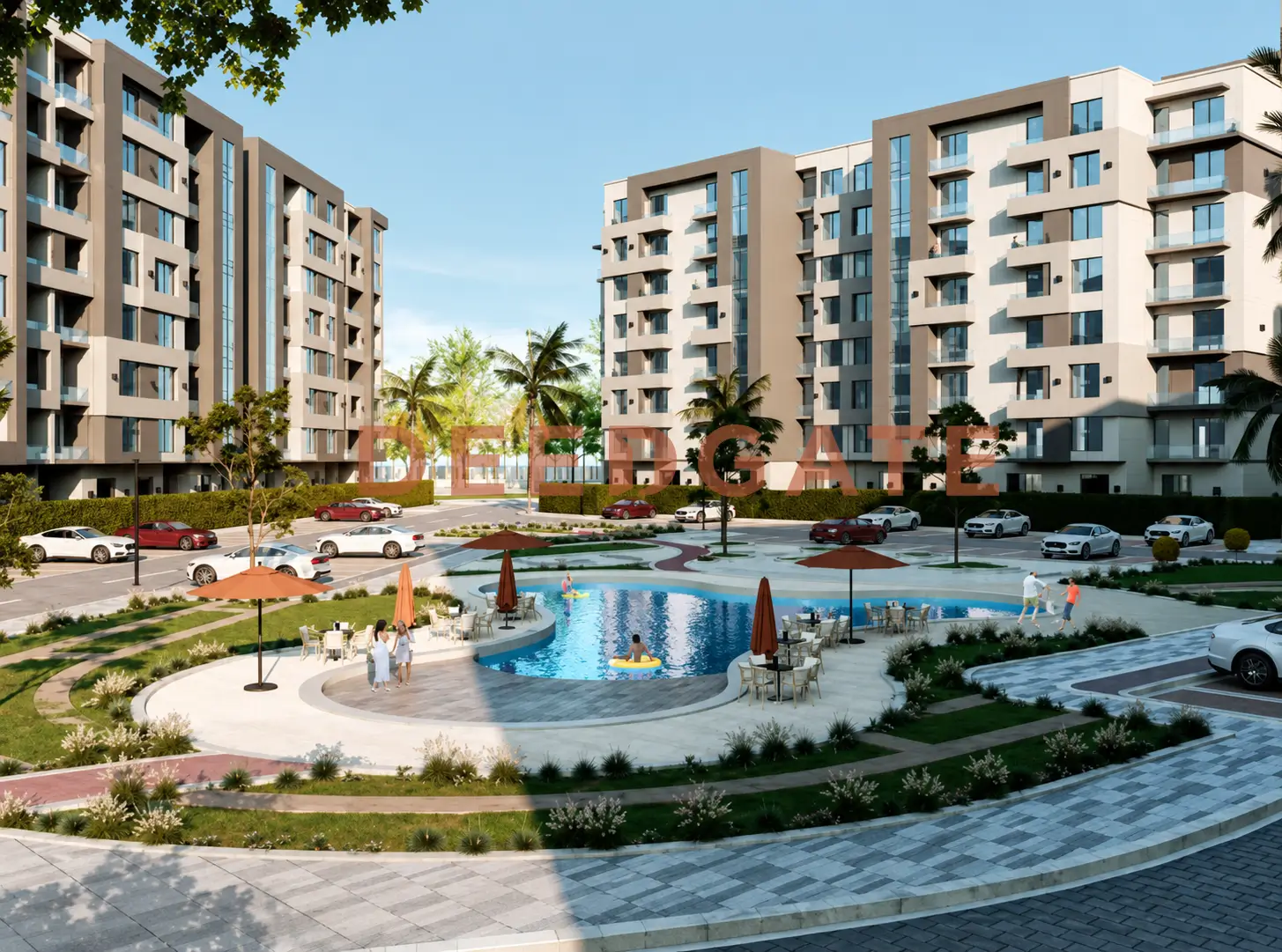
Compound Capital Heights 1 New Capital is a residential compound by Safwa Urban Development (SUD) that spreads across 50 acres inside the Investors Area of the New Administrative Capital, with a building footprint capped at 5% of the land. That single number sets the project apart from most of its neighbours. Where the typical New Capital compound builds on 15% to 25% of its plot, the compound keeps 95% of its 50 acres for green spaces, artificial lakes, and pedestrian walkways, so almost every unit faces landscaping or water rather than another facade.
The compound sits directly on the Central Axis in the northern Investors Area, a position SUD chose because it intersects the Mohamed Bin Zayed Axis, the main artery linking New Cairo to the New Capital. Apartments and duplexes run from 160 m² to 550 m², priced from EGP 5,901,660, with installments stretching to 10 years and no interest. Handover is set for three years from the contract date on a semi-finished basis. The sections below cover the location, the masterplan, the unit mix, the full payment terms, the developer’s record, and an investment read grounded in those facts.
Read More: Compound Castle Landmark New Capital
Why the 5% building ratio at Compound Capital Heights 1 New Capital matters
The building ratio at Compound Capital Heights 1 New Capital is 5% of the total 50 acres, far below the 15% to 25% common across New Capital compounds. The remaining 95% holds green areas, artificial lakes, and walkways, which means low density and a direct landscape view from nearly every unit.
A low footprint changes how the compound lives and how it holds value. Fewer buildings on a large plot translate into more space between blocks, quieter shared areas, and stronger privacy than a densely packed development can offer. Resale value tends to follow scarcity, and a unit inside a 5% built community is rarer than one inside a project that covered a fifth of its land with concrete. The figure is the clearest reason buyers shortlist this compound against denser options on the same axis, and it shapes the lifestyle just as much as the price list does.
Read More: Mall Majal Tower New Capital
Where the compound sits inside the New Administrative Capital
The compound occupies a plot on the Central Axis within the northern Investors Area, a middle ground between the Government District and the main residential zone. SUD selected this land because it meets the Mohamed Bin Zayed Axis, the principal road tying New Cairo to the New Administrative Capital and feeding traffic toward the city’s core districts. The position places residents within a short drive of the landmarks that define the new city, and it gives the compound the road access that a buyer evaluating a long-term home in a still-developing city looks for first.
The Investors Area itself is one of the most active residential belts in the New Capital, filling steadily with serviced compounds as institutions complete their move into the city. Buying inside a maturing cluster rather than an isolated plot reduces the risk of living beside empty land for years, because the surrounding projects bring their own services, retail, and foot traffic. That cluster effect supports the value of the location at handover, when the district is expected to be far more established than it is during construction.
The Mohamed Bin Zayed Axis is the detail that ties this position together. As the main road between New Cairo and the New Administrative Capital, it gives residents a direct route back to the established services and schools of New Cairo while keeping them inside the new city. The Central Axis frontage then carries traffic toward the Government District and the Financial District without threading through residential side streets. For a household weighing a move into a city still under construction, that dual access, one road out to a mature area and one road into the city’s working core, is a practical hedge against the gaps a new city still has.
Landmarks near the compound
- The Diplomatic Quarter and the Embassies District sit minutes from the compound gate.
- The Green River, the largest central park in the Middle East, is a short drive away.
- Al Masa Hotel, the New Capital’s main state hotel, lies close to the project.
- Expo City and the Medical City fall within a short reach.
- The Iconic Tower and the Financial District are minutes away along the Central Axis.
- The Cathedral and the Grand Mosque (Al-Fattah Al-Aleem) stand within the project’s geographic radius.
Neighbouring compounds
The compound shares its stretch of the Investors Area with several residential projects, most notably Le Ciel by Arabia Investments and the Stau compound, alongside Capital Heights 2, the follow-up phase that SUD launched as a continuation of this project. Sitting among service-complete compounds raises the value of the location and signals that the district will be mature by the time units are delivered. Buyers comparing options on this axis often weigh the compound against these neighbours on building density and green ratio, where its 5% footprint gives it a clear point of difference.
Area and urban design
The compound was designed in a European style, with residential blocks arranged around water features and internal gardens. The total area spans 50 acres, equal to roughly 210,000 m², of which only 5% carries buildings and the balance is given to green spaces, artificial lakes, walkways, and services. The masterplan holds 29 residential buildings, each built as a ground floor plus seven recurring upper floors, producing a unit count that serves households of different sizes without crowding the land.
The arrangement is deliberate rather than incidental. Spreading 29 buildings over 50 acres leaves wide gaps between blocks, room for lakes to wind through the site, and clear sightlines from the units to the landscaping. The design choice flows directly from the 5% ratio, and it is what allows the developer to promise a landscape or water view from most units rather than a view onto the next building. For a buyer, the practical result is a compound that reads as open and low-rise despite holding a substantial number of homes.
The seven-floor cap on each building is part of the same logic. Holding the blocks to a ground floor plus seven levels keeps the skyline low and the population per building modest, which is what low density means in practice once you move from the land ratio to daily life. A low-rise block also means fewer households sharing each entrance, lift, and corridor, so the shared spaces stay quieter and easier to maintain. The European-style massing, blocks set around water and gardens rather than packed in rows, is what gives the masterplan its open feel, and it is a direct consequence of having only 5% of the land to build on in the first place. Every structural decision in the plan traces back to that one constraint.
Unit types and sizes at Capital Heights 1
The compound offers two core unit categories, apartments and duplexes, sized for both small households and extended families. Layouts are planned so that most units overlook the gardens or the artificial lakes, and every unit is delivered semi-finished, which lets the buyer complete the interior to personal taste.
| Unit type | Area (m²) | Notes |
|---|---|---|
| Apartments | 160 to 200 | Suited to small families, with garden views |
| Duplexes | 330 to 550 | Two connected floors; some with a private garden, others with an upper level |
The apartments target buyers after a mid-sized home at a reasonable entry cost, which also makes them the natural pick for an investor chasing rental yield. The duplexes serve larger families that want expanded space without moving to a standalone villa, and the larger 550 m² layouts suit a permanent family home or a later resale at a wider margin. Because finishing is left to the owner across both types, each buyer controls the cost and the style of the interior fit-out rather than paying for a finish chosen by the developer.
The duplexes split into two configurations rather than one. A ground duplex pairs its two connected floors with a private garden, which appeals to a family that wants outdoor space of its own inside a gated community. An upper duplex takes the top level instead, trading the garden for height and a wider view across the landscaping and lakes. Both run from 330 m² to 550 m², so a buyer chooses on lifestyle, a garden at ground level or a view from above, rather than on size alone. The apartments, holding to 160 m² through 200 m², stay in the band that rents and resells fastest in the New Capital, which is why they read as the entry point for an investor while the duplexes read as the long-hold family option.
Prices at Capital Heights 1 New Capital in 2026
Unit prices at Capital Heights 1 start from EGP 5,901,660 for the smallest 160 m² apartment, with the final figure shifting by area, floor, and view, whether the unit faces a garden, a lake, or an internal elevation. The numbers reflect the latest list from Safwa Urban Development and sit among the more competitive in the Investors Area once the low building ratio and the Central Axis position are weighed in.
Price should be read against what the figure buys here rather than in isolation. A unit in a 5% built compound on the Central Axis is a different product from a similarly priced unit in a denser project further from the main roads, and the comparison is where the value of this price list shows. Floor and view drive most of the spread within the compound, so two units of the same area can carry different tags depending on whether they look onto water or onto an internal court.
Payment plans and installment terms
Safwa Urban Development structured a payment system that spreads the unit value over a long horizon with no bank interest, giving the buyer room to manage cash flow rather than commit a large sum upfront. The terms are straightforward:
- A contract down payment starting from 15% of the unit value.
- The balance paid over 10 years in equal installments with no interest.
- A maintenance deposit of 5%, payable on handover.
- Handover within three years of the contract date, semi-finished.
The low entry down payment paired with a 10-year horizon makes the compound reachable for salaried buyers and for investors who would rather distribute liquidity than pay a heavy deposit. A long interest-free schedule also lowers the real cost of the unit over time, since the installment stays fixed while incomes and area prices tend to rise. The maintenance deposit funds the cleaning and upkeep that keep the green areas and shared facilities in the condition the masterplan depends on.
Finishing and delivery
Every unit at Capital Heights 1 is handed over semi-finished, meaning the structure, plastering, and core utilities are in place while the interior finish is left to the buyer. Delivery is scheduled within three years of the contract date. Semi-finished delivery suits buyers who want to control the look and the spend of the interior, and it lets an investor finish to the standard a target tenant or resale buyer expects rather than to a generic developer specification. SUD’s track record of meeting handover dates on earlier projects is part of why its delivery commitment carries weight.
Amenities and services inside the compound
Safwa Urban Development built a full set of facilities into the compound so a resident can cover most daily needs without leaving the gates. The amenities split into leisure and retail on one side and security and infrastructure on the other.
Commercial and leisure facilities
- An internal commercial mall across 30,000 m² with shops, restaurants, and cafés.
- Swimming pools in a range of sizes serving different age groups.
- Artificial lakes and water channels that thread through the site and give units panoramic views.
- Health clubs offering spa and jacuzzi services.
- Gyms fitted with current fitness equipment.
Security and infrastructure
- Round-the-clock security at every gate and throughout the compound.
- Surveillance cameras across the compound and at building entrances.
- Self-sensing fire-fighting systems that trigger on smoke detection.
- Backup generators able to run the entire compound during a power cut.
- Regular cleaning and maintenance funded through the 5% maintenance deposit.
The 30,000 m² internal mall is the standout amenity, large enough to hold the everyday retail a household uses week to week, which reduces trips outside the compound and adds footfall value for any commercial interest. The pools, lakes, and walkways are not decorative extras here; they occupy the bulk of the 95% unbuilt land and are the practical expression of the low building ratio that defines the project.
Read together, the amenity set is built to keep daily life inside the gates. A resident can shop, eat, exercise, and use the health club without driving out to the wider city, which matters more in a new urban community where external services are still filling in. The split between leisure facilities and a serious security and infrastructure layer is deliberate. Backup generators that can run the whole compound and self-sensing fire systems address the reliability gaps a new city can have in its early years, while round-the-clock guarding and full camera coverage answer the security question a family asks before committing to a long plan. The maintenance deposit then funds the upkeep that keeps the green areas and the shared facilities at the standard the design assumes, rather than leaving them to degrade after handover.
Safwa Urban Development (SUD), the developer
Safwa Urban Development (SUD) was founded in 1996 by the consulting engineer Mohamed Shalaby and Dr. Medhat Shalaby. The company is among the oldest and largest real estate developers in Egypt, with a portfolio spanning residential, commercial, medical, and tourism projects across Cairo, the Delta, and the New Administrative Capital. Its reputation rests on meeting delivery dates and on the quality of its construction, two factors that matter directly to a buyer paying over a multi-year plan for a unit that is still to be built.
Selected past projects by SUD
- HUB 1 Mall in the New Administrative Capital.
- HUB 2 Mall in the New Administrative Capital.
- High City compound in Obour City.
- Capital Heights 2 in the New Capital, the continuation phase of this project.
- A group of residential towers in Cairo and the Delta.
- Al Safwa Medical Tower and Mavericks International School.
A track record that stretches back to 1996 is a meaningful signal in the New Capital, where many sellers are recent entrants without a delivery history. A developer that has handed over malls, towers, schools, and medical buildings carries less completion risk than a first-time name, and that lowered risk is part of what a buyer is paying for when choosing this compound over a cheaper unit from an untested developer.
The breadth of SUD’s portfolio matters as much as its age. A company that has delivered the HUB 1 and HUB 2 malls inside the New Capital already understands the city’s approvals, infrastructure, and construction conditions firsthand, rather than entering the market cold. Its work across residential, commercial, medical, and educational buildings means it has run projects with very different technical demands, from the retail mechanics of a mall to the standards of a medical tower and a school. For a buyer, that diversity reads as operational depth: the team behind the compound has solved a wide range of delivery problems before, which is the kind of experience that keeps a multi-year, semi-finished handover on schedule. The continuation of the brand into Capital Heights 2 on the same axis also signals that the developer is committed to the area rather than building once and leaving.
Investment read on Capital Heights 1
The investment case for Capital Heights 1 rests on three measurable pillars: the location, the low building ratio, and the developer’s record. The Central Axis position next to the Government District and the Financial District places the compound inside the expected rental demand from government and banking staff once institutions finish relocating into the city. That demand base is the foundation of any yield argument here, and it is tied to facts already on the table rather than to general optimism about the New Capital.
The 5% building ratio supports resale value because a unit in a low-density community is scarcer than one in a compound that built on more than 20% of its land, and scarcity is what lifts a resale price. SUD’s history since 1996 reduces the risk of a delayed handover compared with newer developers in the same city, which protects the buyer’s timeline and the capital tied up in the plan. On unit choice, the 160 to 200 m² apartments fit an investor targeting shorter-term rental return, while the larger 330 to 550 m² duplexes suit a buyer after a permanent extended-family home or a later resale at a higher margin.
The compound fits a specific profile better than a general one. It suits a salaried buyer who can meet a 15% down payment and prefers a long interest-free plan over a heavy upfront sum, and it suits an investor who values the Central Axis demand base and the scarcity of a low-density unit. It fits less well a buyer who needs a fully finished, move-in-ready home on a short timeline, since units arrive semi-finished and three years from contract, and it fits less well anyone seeking a standalone villa, which this apartment-and-duplex compound does not offer. Reading the project against that match, rather than against a generic checklist, is the clearest way to judge whether it answers a given buyer’s brief. This analysis is for guidance only and is not investment advice.
One concern that rarely appears on a developer brochure is the question of selling a unit before handover. With a three-year build and a 10-year plan, a buyer’s circumstances can change well before the keys are handed over, so the ability to assign a contract to another buyer is a real consideration rather than a hypothetical one. The low building ratio works in the seller’s favour here, because a scarce low-density unit is easier to pass on at a fair price than a unit in a crowded project where supply is high. The exact terms of any pre-handover assignment, and any fees attached to it, are set by the developer and should be confirmed in writing before contracting, alongside the delivery commitment and the penalties that apply if handover slips beyond the stated three years.
Ownership running costs deserve the same scrutiny as the headline price. The 5% maintenance deposit paid on handover funds the upkeep of the green areas, the lakes, the pools, and the shared facilities, and a compound that gives 95% of its land to landscaping carries a real maintenance load to keep that landscaping in the condition the design promises. A buyer should treat that deposit, and any recurring service charge that follows it, as part of the true cost of the unit rather than an afterthought, because the value of a low-density compound depends on those facilities being maintained over the long term rather than allowed to slide after the developer moves on.
Read More: Mall Linq 30 New Capital
Frequently asked questions about Capital Heights 1 New Capital
What is the price per meter at Capital Heights 1 New Capital?
Prices at Compound Capital Heights 1 New Capital start from EGP 5,901,660 for a 160 m² apartment, and the price per meter varies by floor, view, and unit type. The final figure is confirmed when you contact the developer for an updated quote on a specific unit.
What unit types are available at Capital Heights 1?
Compound Capital Heights 1 New Capital offers two unit types: apartments from 160 m² to 200 m² and duplexes from 330 m² to 550 m². All units are delivered semi-finished, and the project is handed over within three years of the unit contract date.
Who is the developer of Capital Heights 1?
Compound Capital Heights 1 New Capital is developed by Safwa Urban Development (SUD), founded in 1996. Its portfolio includes HUB 1 and HUB 2 malls in the New Capital, High City compound in Obour, and Capital Heights 2, the continuation phase of this project.
When does Capital Heights 1 deliver?
Compound Capital Heights 1 New Capital is handed over within three years of the unit contract date, on a semi-finished basis that lets the buyer complete the interior to personal taste. SUD has a record of meeting delivery dates on its earlier projects.
What is the payment plan at Capital Heights 1?
Compound Capital Heights 1 New Capital offers a contract down payment starting from 15% of the unit value, with the balance paid over 10 years in equal interest-free installments, plus a 5% maintenance deposit due on handover. The plan keeps the compound within reach of a wide range of buyers.
What is the total area of Capital Heights 1 and how much is built?
Compound Capital Heights 1 New Capital spans 50 acres, about 210,000 m², with buildings on just 5% of the land and 95% given to green spaces, artificial lakes, and walkways. The masterplan holds 29 residential buildings, each a ground floor plus seven upper floors, which keeps density low across the site.
What makes Capital Heights 1 different from nearby New Capital compounds?
Compound Capital Heights 1 New Capital differs from its neighbours mainly through its 5% building ratio, well under the 15% to 25% common nearby, paired with a Central Axis position that meets the Mohamed Bin Zayed Axis. The combination delivers lower density, landscape views from most units, and direct road access toward the city’s core districts.
Conclusion
Compound Capital Heights 1 New Capital combines a Central Axis position in the New Administrative Capital, a building ratio held to 5% of its 50 acres, and a developer working since 1996. Those three elements form the core of the buying decision for anyone after a residential unit or an investment in the Investors Area. To check updated prices or arrange a viewing, get in touch through the form on this page.