
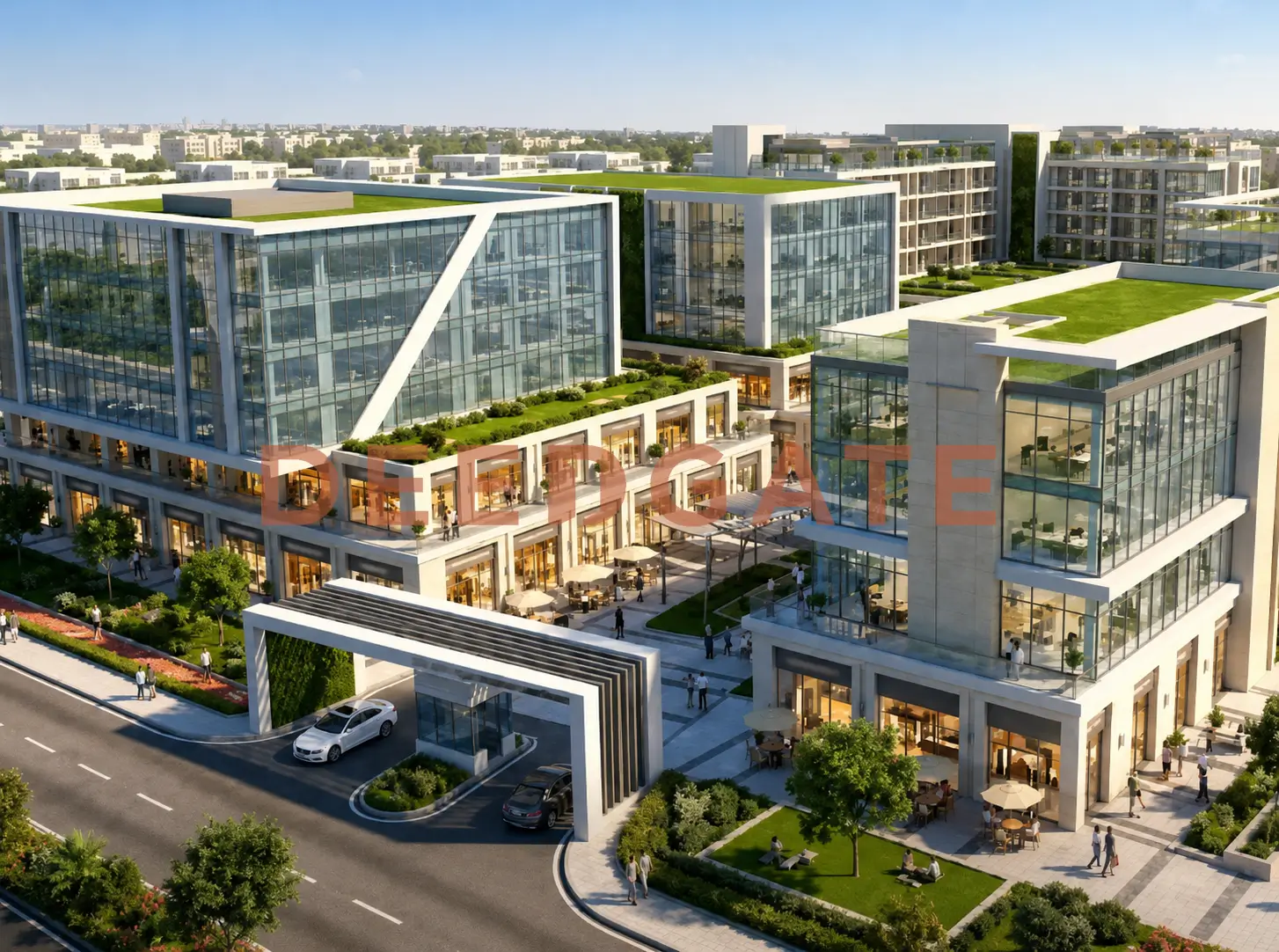
Mall The Walk New Capital reached the market in July 2026 with six operating partners already signed by name, which is the rarest thing about it. Dubai Developments, the Saudi-founded developer marketing the scheme as WALK’N Mall October, secured Vodafone for the smart infrastructure, UFC Gym for the fitness floor, RECO for the entertainment zones, Rsoukh of Saudi Arabia as an investment partner, Hafez Engineering Consultants for the architecture and Acadio for the brand identity, and announced all six in one release at launch. Most new Egyptian malls sell units first and hunt for operators afterwards, which is exactly how a building ends up finished and empty.
The physical proposition sits on 10 acres fronting the Old Central Axis in 6th of October City, roughly 20 metres from Al Nagda Square in the First District. Units start at 28 m² and the announced price per metre opens at EGP 55,900, spread across four activities inside one building: retail shops, administrative offices, medical clinics and hotel apartments. What follows covers the site, the vertical layout, every published size and rate, the booking terms as they currently stand, and a grounded read on where the money actually works and where it does not.
Six operators named before a single unit opens
Dubai Developments closed six partnerships for the project and disclosed them together at the July 2026 launch, so the mall enters the market with an operating stack rather than an empty shell looking for tenants. Each name carries a defined role, and the practical effect on unit owners is measurable rather than promotional.
- Rsoukh (Saudi Arabia): investment partner in the project, adding Gulf funding cover to the launch.
- Hafez Engineering Consultants: architectural designer, led by engineer Mohamed Hafez, an office with an extended track record in the Egyptian market.
- Vodafone: responsible for the smart infrastructure and digital transformation layer, from the communication networks to the building operating systems.
- UFC Gym: the global fitness brand takes over management and operation of the sports facility inside the mall.
- RECO: runs the entertainment activities across the project.
- Acadio: handles the commercial identity and creative communication for the mall.
Read those names as traffic mechanics, not marketing. A gym under international management generates repeat daily visits across all twelve months rather than seasonal peaks, and professionally managed entertainment extends dwell time per visitor. Ready digital infrastructure cuts the fit-out cost a tenant carries before opening. Shops, clinics and offices all feed on the same footfall those three produce, which is why the operator list belongs in a buying decision and not just in a press release.
Read More: Prime Plaza Mall October
Where exactly does the mall sit, and what surrounds it?
Mall The Walk New Capital sits directly on the Old Central Axis in 6th of October City, about 20 metres from Al Nagda Square in the First District, with the 26 July Axis, Wahat Road and the Dahshour Link all a few minutes away. That places it inside the city’s oldest and densest residential belt rather than its outer expansion zones.
The Central Axis is the artery 6th of October was founded on, and it cuts through the residential districts that filled up years ago. Choosing a plot on that axis instead of the newer extension areas means the pedestrian and vehicle traffic in front of the building exists today and is not waiting on future residents to move in. The First District specifically ranks among the earliest districts built in the city, so its population base is settled rather than forming, and Al Nagda Square already functions as a known service point on routes locals drive every day.
- Al Nagda Square, First District: 20 metres separate the square from the project land.
- 26 July Axis: a few minutes by car, and the fastest connection to Sheikh Zayed and the city’s main entrances.
- Wahat Road and the Dahshour Link: minutes away, opening access from October Gardens and the southern zones.
- Mall of Arabia and Mall of Egypt: both within the immediate catchment, confirming the area is an established shopping district rather than an emerging one.
- Remaya Square and Gohayna Square: direct routes for visitors arriving from Giza, Mohandessin and from inside October itself.
- October 6 University: a short distance away, adding a daily layer of students and staff to the mall’s audience.
6th of October City as a finished catchment, not a city under construction
6th of October City launched at the end of the 1970s and today holds a major industrial zone, several private universities, hospitals and international schools, alongside the two largest malls in West Cairo. That service maturity is what gives commercial projects on its older axes a ready audience from opening day, which is a materially different starting position from a mall in a city still assembling its first residents.
The proximity of Mall of Arabia and Mall of Egypt cuts both ways and deserves an honest reading. On one side, the surrounding population is already trained to shop within a short drive of this plot, so no one has to build a shopping habit from zero. On the other, those two anchors compete directly for the same visitor spend, which is why the tenant mix on the ground floor matters more here than the raw footfall number.
The catchment also arrives in layers rather than one flow. October 6 University feeds a student and staff population through the surrounding streets on weekdays, the industrial zone supplies working traffic that peaks at shift changes, and the First District supplies evening and weekend residential demand. A mall combining retail, clinics, offices and hotel apartments is positioned to draw on all three at different hours, which is a more stable occupancy profile than a single-activity building depending on one audience.
Ten acres, a ground floor and five levels, with activities split vertically
The land spans 10 acres, and the larger share of it went to the plaza, the services and the open areas, with the building occupying the remainder. The name explains the intent: WALK’N derives from walking, pointing to an open-mall model built on visitors moving on foot between the plaza and the units, which is why the built mass was deliberately reduced in favour of open space.
The structure comprises a ground floor plus five repeated floors, with glass façades distributing natural light and ventilation across the units. The vertical distribution of activities is fixed in the masterplan rather than left to whoever buys first. Retail takes the lower levels where pedestrian flow concentrates, while offices and clinics take the upper floors where quiet and privacy are conditions of the business. That separation prevents the activities from colliding: a clinic patient does not walk through restaurant crowds, and a shop owner gets the highest point in the visitor stream.
Unit sizes and published price per metre by activity
Unit areas stay inside a deliberately small band that opens at 28 m², a choice that lowers the entry ticket and widens the pool of buyers who can transact. The table below sets out the four activities with their starting size and the announced rate for each.
Read More: Down Town Mall 6 October
| Unit type | Area starts from | Price per metre (EGP) |
|---|---|---|
| Retail shops | 31 m² ground floor / 29 m² first floor | 94,000 to 155,000 |
| Administrative offices | 31 m² | 59,000 |
| Medical clinics | 28 m² | 79,000 |
| Hotel apartments | 39 m² | 55,900 |
Every type occupies its own operating zone. Retail holds the ground and first floors where pedestrian flow peaks, and the wide spread in its rate normally traces back to the unit’s position and frontage inside the mall rather than to any difference in build quality. An office from 31 m² fits start-ups and the law and accounting practices that need a small team physically close to clients in October, without paying for floor area they will never use.
The 28 m² clinic is a working measurement for a specialist consulting room, and its commercial logic rests on the First District’s settled population: residents currently drive to medical centres further out for visits that a nearby clinic could absorb. The 39 m² hotel apartment behaves as a rental income instrument more than a place of business, and it draws on both the daily axis traffic and the nearby October 6 University audience.
Units hand over under two systems, semi-finished and fully finished, depending on the unit. Semi-finishing lets medical and administrative owners fit out to their own identity and equipment requirements, while full finishing compresses the time between handover and the first day of trading for anyone who wants to reach the market faster.
What is the price per metre at Mall The Walk New Capital?
The price per metre at Mall The Walk New Capital starts from EGP 55,900 for hotel apartments, reaches EGP 59,000 for administrative offices and EGP 79,000 for medical clinics, while retail ranges between EGP 94,000 and EGP 155,000. Prices were updated in July 2026 and remain subject to revision as the launch phases progress.
Translating the rate into a whole-unit figure gives a clearer sense of the capital required. Multiplying each smallest published area by its own rate puts an office at roughly EGP 1.83 million for 31 m², a hotel apartment at roughly EGP 2.18 million for 39 m², a clinic at roughly EGP 2.21 million for 28 m², and a first-floor shop at roughly EGP 2.73 million for 29 m². These are indicative calculations meant to size the investment, not official price lists issued by the developer.
For a benchmark inside the same city, units at Centrada Believe Mall October, a recent administrative launch in 6th of October, are marketed from around EGP 120,000 per metre. That places this project’s entry point at a visibly lower level, although the unit types, floors and positions differ enough that the comparison stays indicative rather than exact.
Reservation, down payment and installment terms as they stand
The developer set the serious reservation amount at EGP 50,000 for all four unit types, from the hotel apartment through to the retail shop, so the entry gate is identical regardless of the rate the unit carries. Contracting is then completed with a down payment the company describes as small, followed by installments on the balance across several years with no interest applied.
- Reservation deposit: EGP 50,000, uniform across retail, offices, clinics and hotel apartments.
- Down payment: described by the developer as a small percentage, with the exact figure not published to date.
- Installments: the balance spread over several years without interest, with the number of years not yet announced.
- Market reference: payment plans published across October malls launched during 2025 and 2026 typically move between a 0% and 30% down payment with 4 to 7 year terms, as seen at Park Yard and Sky Walk October.
The exact down payment percentage and the number of installment years had not been officially announced as of this page’s update, so ask for both in writing before committing any money. The market range above is worth carrying into that conversation, because it gives you a real reference point to negotiate against once the final schedule is published rather than accepting the first plan offered.
When does the project hand over?
Mall The Walk New Capital has no announced handover date yet. Dubai Developments launched the project officially in July 2026 and construction remains in its early stages. Buying now means securing the first-launch rate in exchange for waiting out the build, and the date will be updated on this page once the company confirms it.
When you enquire, record which finishing system your target unit carries, because semi-finished and fully finished units separate at handover by the fit-out period that follows. That gap decides when the unit actually starts trading or seeing patients, and for an income-producing purchase it matters as much as the handover date itself.
Facilities and services inside the mall
The company equipped the project with a facilities package covering operations, circulation, business needs and leisure, and contracted a specialist management and operation company to keep services running around the clock, without naming that operator yet. The main facilities group by function as follows.
- Operating infrastructure: backup electrical generators, fire-fighting systems, emergency staircases, central air conditioning, high-speed internet networks provisioned by Vodafone, and scheduled maintenance and cleaning services.
- Security and access: electronic gates regulating entry and exit, surveillance cameras covering the building, and security personnel working 24 hours.
- Circulation and parking: garages sized for visitors across all four activities, panoramic elevators, and escalators connecting the six levels.
- Business and financial services: equipped meeting rooms, reception desks at the entrances, and ATM machines.
- Retail and leisure: a commercial centre, cafés and restaurants, a kids area, open plaza and green spaces, and the fitness facility operated by UFC Gym.
Two details in that list carry weight for an owner rather than a visitor. Central air conditioning and Vodafone-provisioned networks arrive as building systems, so a clinic or an office does not budget separately for cooling plant and connectivity during fit-out. Parking sized for four simultaneous activities matters just as much on the Central Axis, where on-street capacity is already absorbed by existing residents and a shortage of spaces translates directly into lost visits.
Dubai Developments: from Saudi Arabia into West Cairo
Dubai Developments started operating in the Kingdom of Saudi Arabia in 2001 and has since executed more than 150 projects and delivered close to 10,000 residential units, according to chief executive Mohamed Abo Seada speaking at the project launch. Inside the Egyptian market the company concentrates its activity on West Cairo, a geographic focus that keeps management physically near its running sites instead of stretched across distant regions.
This mall is not the company’s only move for 2026. It has announced The Address, followed by Dubai Mall and Strip 13 Mall, alongside a planned expansion into East Cairo and the North Coast. The volume of previous deliveries indicates execution capacity, with one qualification a buyer should weigh: the company’s record inside Egypt is newer than its Saudi record, a gap that the entry of a Gulf investment partner into this specific project partly offsets.
Investment read: what supports the case and what to watch
The investment thesis rests on three verifiable pillars. The first is a position on an artery whose density is already complete, since the First District and its surroundings have held actual residents for decades, so the traffic retail needs exists today rather than in a future masterplan. The second is a relatively low entry ticket, because units of 28 to 39 m² put the starting investment near EGP 1.8 million, a level that widens the buyer base and makes an eventual resale easier to execute.
The third is the declared operator model, where an internationally managed gym and professionally run entertainment raise the probability of early occupancy, repeat visits and a working return. Timing adds a fourth factor: buying at the first launch is historically the lowest point on any project’s pricing curve, ahead of the staged increases that normally arrive as construction advances.
Three points deserve attention before signing. The project is under construction with no announced delivery date, so the buyer carries a timing risk that the first-launch price is meant to compensate. The payment schedule has not been published in full, and the wide spread in the retail rate, running up to EGP 155,000 per metre, demands a careful feasibility study of the intended activity before booking a ground-floor shop. The presence of Mall of Arabia and Mall of Egypt nearby is likewise double-edged, supplying an established shopping density in the surrounding area while competing directly for the same visitor spend.
Read More: Mehwar Plaza Mall 6 October
On fit, the project works for a doctor looking for a 28 m² clinic inside an existing population density, for a first-time investor whose budget lands between EGP 1.8 and 2.7 million, and for a buyer who wants rental income through a hotel apartment without running a business personally, provided they confirm which party will operate and lease the hotel units. It does not suit anyone who requires immediate handover or rental cash flow from the first month. This analysis is guidance only and is not an investment recommendation.
Frequently asked questions
Who is the developer of Mall The Walk New Capital?
Mall The Walk New Capital is developed by Dubai Developments, a company founded in Saudi Arabia in 2001 that has executed more than 150 projects and delivered close to 10,000 residential units. Its chief executive is Mohamed Abo Seada, and its Egyptian activity concentrates on West Cairo.
How much is the reservation deposit?
The reservation deposit at Mall The Walk New Capital is EGP 50,000, applied uniformly to retail shops, administrative offices, medical clinics and hotel apartments. Contracting follows with a down payment the developer describes as small, then interest-free installments over several years whose exact terms are not yet published.
What is the smallest unit available?
The smallest unit at Mall The Walk New Capital is a 28 m² medical clinic. Administrative offices and ground-floor retail start at 31 m², first-floor retail at 29 m², and hotel apartments at 39 m², keeping the whole product inside a compact size band by design.
Are units delivered finished?
Units at Mall The Walk New Capital are delivered either semi-finished or fully finished, depending on the unit. Semi-finished suits clinics and offices that need to fit out to their own specification, while fully finished shortens the period between handover and the start of actual trading.
Summing up
Three numbers carry the offer: 10 acres on the Old Central Axis, units opening at 28 m², and a rate starting from EGP 55,900 per metre, wrapped around six operating partners named before the mall opens. The unresolved items are the handover date and the final payment schedule, and both belong on your question list. To ask about updated prices, available sizes, or to arrange a viewing, send your request through the contact form on this page.