
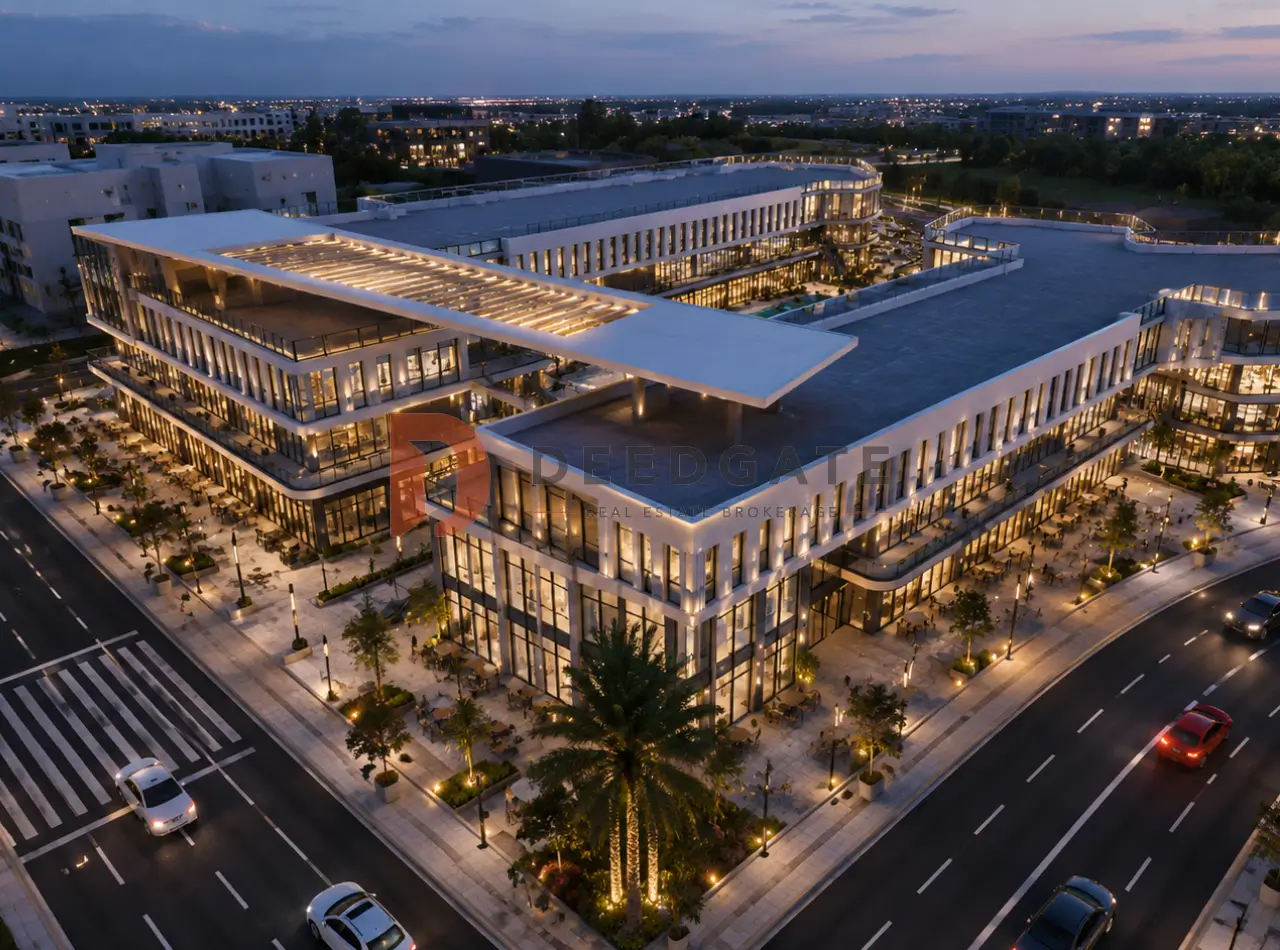
Mall Plaza Vida October is a mixed commercial, administrative and medical mall developed by Kayan Real Estate Development on Central Street in the First District of 6th of October City, spanning 7,000 m² with unit prices starting from EGP 3,210,000. The mall opens on a district that was fully populated and fully serviced years before construction started, which is the single attribute that separates it from most retail projects launched in Greater Cairo today. Buyers here are not underwriting a future catchment. The schools, universities, clubs, hospitals and large malls that generate the footfall already exist within a short drive of Central Street.
The second distinctive attribute is the entry ticket. Unit areas begin at 22 m², reservation deposits start at EGP 30,000 for medical clinics, and the down payment starts at 10% with the balance spread across up to 8 years. That combination puts a titled commercial asset in west Cairo within reach of an individual investor rather than only an institutional one, and it is the reason the project reads differently from the large-format October malls that price entry in the tens of millions. The sections below set out the location and its access network, the floor logic across the 7,000 m², the unit mix and sizes, the price list and payment structures, the operating and security systems, the developer’s track record, and a grounded read on where the investment case is strong and where it is not.
Where exactly is Mall Plaza Vida October?
Mall Plaza Vida October sits on Central Street inside the First District of 6th of October City, in the older and denser core of the city rather than on its expanding western edge. The position places the mall among established residential blocks, retail strips and service buildings, so daily pedestrian and vehicle traffic already passes the plot. Access runs through the 26th of July Corridor, the Alexandria Desert Road and the Dahshur Link.
The First District is one of the original neighbourhoods laid out when 6th of October City was founded, which matters commercially in a way that a newer plot cannot replicate. Its residents are settled owners rather than first-wave buyers, its street network is complete, and its utilities were connected decades ago. A retail unit delivered into that environment starts trading against an existing resident base instead of waiting for a district to fill up, and that is the practical difference between an operating asset and a speculative one.
Three separate road corridors feed the mall, which spreads its catchment rather than tying it to a single artery. The 26th of July Corridor carries traffic between 6th of October and central Cairo and delivers the largest share of visitors from outside the city. The Alexandria Desert Road connects the mall to Giza and the northern satellite cities, while the Dahshur Link shortens the trip from south Giza and the Saqqara side. A tenant assessing catchment risk should note that no single road closure isolates the property.
The landmarks and traffic generators around the mall
Retail performance in 6th of October depends less on the plot itself than on what surrounds it, and the ring around Central Street contains an unusually broad mix of daily, institutional and tourist traffic. The list below names the entities that feed the mall and what each one actually contributes.
- 26th of July Corridor: the main artery linking 6th of October City to Greater Cairo, and the route most out-of-city visitors use to reach the mall.
- Alexandria Desert Road and the Dahshur Link: two secondary entry points that connect the mall to neighbouring cities and cut travel time from south Giza.
- Remaya Square and Gehenah Square: two high-volume traffic nodes on the October side of Giza that push a constant stream of passing drivers and pedestrians through the surrounding streets.
- October University and Media Production City: two permanent generators of students, staff, crews and visitors across the working week, not only at weekends.
- Mall of Egypt and Mall of Arabia: two large regional shopping destinations nearby whose presence confirms that the surrounding trade area is commercially mature and already tested.
- Al Safwa Hospital and Wadi Degla Club: established medical and sports facilities serving the same catchment, and natural referral neighbours for the clinics inside the mall.
- The Grand Egyptian Museum: a global tourist destination on the Giza plateau side, adding an international visitor layer that almost no other October mall can claim.
- Mountain View October Park and The Axis October: two upscale residential communities in the immediate surroundings whose households lift the average purchasing power of the mall’s likely customer base.
The Grand Egyptian Museum deserves separate treatment because it changes the demand profile rather than just adding volume. A mall serving only residents lives on weekday convenience spending and weekend family trips, whereas proximity to a museum of that scale layers seasonal international footfall on top. Food and beverage tenants and service retail benefit most from that second layer, since visitor spending concentrates in cafés, restaurants and quick retail rather than in big-ticket categories.
Read More: Mehwar Plaza Mall 6 October
The nearby upscale compounds work on the same logic from the opposite direction. Mountain View October Park and The Axis October house buyers in a higher income bracket than the October average, and their residents shop and take appointments inside the same radius. For a clinic or a specialist retail brand inside the mall, that neighbouring purchasing power is a more reliable indicator of achievable pricing than the city-wide average.
Masterplan and floor logic across 7,000 m²
Mall Plaza Vida October occupies 7,000 m², and Kayan Real Estate Development allocated the larger share of that footprint to landscaped areas and a central plaza, leaving the remainder to the buildings themselves. That allocation is unusual for a commercial project on a compact plot, where the default is to maximise leasable floor area. The trade is deliberate: fewer units, more open frontage, and views onto greenery rather than onto an internal corridor wall.
The plaza also functions as a dwell-time device. Visitors who sit, wait or meet inside a project stay longer, and longer stays translate directly into higher spend per visit for the food and beverage tenants that face the open area. A compact mall with a genuine outdoor core competes on a different basis from an enclosed October mall of ten times the size, because it targets repeat local visits rather than a full-day destination trip.
Kayan Real Estate Development commissioned specialist architectural consultants for the facade, executed in a contemporary European idiom with a clear functional split between the commercial, administrative and medical components. The vertical zoning follows the traffic rather than the drawing. The ground and first floors carry the retail units so they capture the heaviest circulation, while the second floor holds the administrative offices and medical clinics that need quiet and privacy. Separating the two flows raises the operating efficiency of each activity and keeps a patient waiting for an appointment out of the middle of shopping traffic.
Unit types, floors and sizes across the three levels
The mall combines retail shops, administrative offices, medical clinics and pharmacies, with areas beginning at 22 m² and scaling up from there. That range lets a buyer size the unit to the activity and to the capital available rather than accept a fixed format. The table sets out the starting area by unit type and floor.
Read More: Prime Plaza Mall October
| Unit type | Floor | Area starts from (m²) |
|---|---|---|
| Retail shops | Ground | 37 |
| Retail shops | First | 22 |
| Administrative units and clinics | Second | 31 |
Ground-floor shops open directly onto the plaza and the landscaped areas, which makes them the strongest fit for activities that live on visibility and walk-in traffic. Restaurants, cafés and larger retail outlets extract the most value from that frontage, because an outdoor seating spill and a visible shopfront do more for them than additional internal depth. These are the highest-priced units in the mall for exactly that reason.
First-floor shops start smaller, from 22 m², and carry a lower total ticket. They suit specialist brands, service counters and quick-service concepts that need a presence inside the mall rather than a street-facing window. For an investor buying to lease rather than to operate, this floor offers the lowest capital outlay per unit in the retail category.
Second-floor administrative units and clinics start from 31 m² and serve professional offices and healthcare providers who want a calm working environment close to the mall’s pharmacies and support services. A clinic on this floor benefits from the retail traffic below without absorbing its noise, and shares the building with pharmacies that complete the medical offer. Small offices in this band are also the easiest units to re-let, since demand for compact professional space in an established district is broad and consistent.
Unit prices and price per meter
Prices at Mall Plaza Vida October start from EGP 3,210,000, with a price per meter starting at EGP 60,000 for administrative and medical units. The figures are current for 2026 and shift with unit type, floor, area and orientation toward the plaza. Any final price depends on the specific unit selected at the time of reservation.
Read against the mall’s position in the First District and the maturity of the surrounding trade area, that entry price is competitive rather than aggressive. The published sample units below show how the price ladder actually works across the three floors.
- Medical clinic, 42 m²: from EGP 3,210,000.
- First-floor retail shop, 44 m²: EGP 5,282,400.
- Ground-floor retail shop, 48.5 m² internal plus 32 m² external: EGP 10,568,000.
- Pharmacy, 88 m²: EGP 22,195,000.
The ladder tells a clear story about how the developer values position. A first-floor shop and a ground-floor shop of roughly comparable internal area sit far apart in price, because the ground-floor unit carries external area and direct plaza frontage. The pharmacy sits at the top of the list, reflecting both its size and the exclusivity that a pharmacy licence carries inside a mall that also houses clinics. An investor comparing options should read the gap between the first and ground floors as the cost of visibility, and decide whether their intended tenant actually monetises it.
For a buyer targeting rental income rather than direct operation, the smaller clinic and first-floor retail units carry the more manageable capital exposure and the shorter re-letting cycle. For an owner-operator with a food and beverage concept, the ground-floor premium is defensible, since plaza frontage in a compact mall is a finite resource and the units that hold it cannot be reproduced later.
Payment plans, reservation deposits and the entry barrier
Kayan Real Estate Development set two payment structures so buyers can match the schedule to their liquidity rather than to a single fixed formula. The first plan lowers the upfront commitment; the second lowers the monthly burden in exchange for a larger deposit.
- Plan one: 10% down payment, with the balance of the unit price installed over 7 years.
- Plan two: 20% down payment, with the balance distributed over 8 years.
- Reservation deposit, retail shops: from EGP 50,000.
- Reservation deposit, medical clinics: EGP 30,000.
The two plans answer different buyer profiles rather than simply offering a choice. A buyer with limited liquidity enters at 10% and accepts a heavier instalment across 7 years, which suits an investor holding the unit through construction and letting it on delivery. A buyer with stronger cash reserves pays 20% and gains an extra year of amortisation, which lowers the monthly outflow and improves cash-flow cover once the unit is operating.
The reservation deposits are the more telling number. At EGP 30,000 for a clinic and EGP 50,000 for a shop, the cost of holding a unit while completing due diligence is low by the standards of commercial launches in 6th of October, where five and six-figure serious-deposit requirements are common. That lowers the practical entry barrier for individual investors and widens the pool of buyers competing for the better-positioned units, which in turn tends to clear plaza-facing stock first.
When does the mall hand over?
Mall Plaza Vida October hands over within 3 years of contract signature, with units delivered in a finishing condition prepared for commercial operation. The window lets a buyer pay down a meaningful share of the price before the unit starts trading, and gives Kayan Real Estate Development time to execute against the specification agreed at contract.
The handover condition matters as much as the date. Units delivered ready for commercial fit-out shorten the gap between receiving keys and generating income, because the tenant’s work is limited to interior fit-out rather than base building completion. For a clinic or a small office, that difference can compress the vacant period after delivery from months to weeks.
The three-year horizon also carries the project’s clearest drawback. A buyer who needs an immediately trading asset, or an operator with a business that cannot wait, is not the right buyer for this mall. That constraint should be weighed openly against the lower entry price, because the discount to a delivered, operating unit is precisely the compensation for the waiting period.
Facilities, operating systems and security
Kayan Real Estate Development equipped the mall with an operating and security package aimed at keeping tenants trading without interruption and preserving the asset’s value for owners. The systems combine facility management technology, round-the-clock security and support services for the retail, administrative and medical components.
- Electronic entrance gates that regulate visitor flow and reduce congestion at peak hours.
- Smart facility-management systems controlling the mall’s building services and operating efficiency.
- Panoramic lifts and escalators moving visitors between the three floors.
- Fully secured car parking for visitors and for staff working inside the units.
- A trained security team operating 24 hours a day, supported by surveillance cameras covering the full property.
- Firefighting systems and backup power generators protecting continuity of operation.
- Reception desks directing visitors and unit owners inside the mall.
- Meeting rooms fitted with current presentation technology, serving the administrative units.
- High-speed internet networks supporting business activity inside the units.
- A varied mix of retail outlets and restaurants serving visitors and the people working on site.
- Daily maintenance covering the building and its shared facilities.
Two items in that list carry disproportionate weight for a commercial owner. Backup generators and firefighting systems reduce the risk of forced closure, and a tenant evaluating a lease in Egypt prices continuity risk explicitly, because a day of unplanned closure is a day of lost revenue with rent still accruing. Round-the-clock security and full camera coverage serve the same function for medical tenants, who hold controlled stock and patient records and cannot operate in a loosely supervised building.
Daily maintenance and smart facility management are the items that determine how the asset looks in year five rather than year one. Commercial resale values in October track building condition closely, and a mall that degrades visibly loses tenants to newer stock regardless of location. The presence of a defined maintenance regime is therefore an argument about future value, not only about present comfort.
Read More: Down Town Mall 6 October
Kayan Real Estate Development and its west Cairo portfolio
The mall is developed by Kayan Real Estate Development, a company with more than 20 years of activity in the Egyptian property market. That length of trading history allows the developer to read what commercial and administrative investors need and to price a product that balances location, specification and payment terms. Its stated record points to delivery on the announced schedules and to the specifications agreed at contract, which is the relevant risk measure for a buyer committing to a project that hands over within 3 years.
The company’s portfolio concentrates on commercial and mixed-use assets rather than spreading across every asset class. The Location Mall in October Gardens and Hub 44 in Sheikh Zayed sit alongside Plaza Vida in 6th of October, and all three occupy the same corridor of west Cairo. That geographic focus builds specialist knowledge of one submarket, including its tenant mix, its rent levels and its absorption rates, which is more useful to a commercial buyer than a broad portfolio spread thinly across the country.
A buyer performing due diligence should treat the portfolio as a checkable claim rather than a marketing line. Visiting a delivered Kayan mall in October Gardens or Sheikh Zayed shows the finishing standard, the current occupancy and how the common areas have aged, and those observations predict the outcome at Plaza Vida better than any brochure.
Why the project works as a commercial investment
Mall Plaza Vida October rests its investment case on three measurable factors: a First District address inside an existing population rather than a district awaiting development, a unit mix starting at 22 m² that lowers the capital threshold, and a developer with more than 20 years of market activity that reduces execution risk. Together they make the mall an operating asset at handover rather than a bet on a future neighbourhood.
Commercial values in 6th of October have followed an upward path driven by continuous population growth and by the city’s expanding urban footprint. Against that background, the 3-year construction period converts from a waiting cost into a window for locking in today’s price ahead of expected increases, which raises the prospect of a capital gain measured at handover when operation begins. That inference rests on the area’s demonstrated growth trend and on the stated delivery schedule, and it is not a guaranteed outcome.
The unit mix splits the investment case in two. Smaller units on the first and second floors suit a buyer pursuing rental yield, since a lower purchase price and steady demand for compact retail and professional space shorten void periods. Ground-floor shops with plaza frontage suit an owner-operator running the business directly, because that buyer captures the trading value of the frontage rather than paying for it and re-letting it at a margin.
Set against the neighbouring October malls, the entry price of EGP 3,210,000 places the project inside the competitive band of the local market, where comparable commercial and administrative launches in the city start between roughly EGP 2.6 million and EGP 4.7 million. Combined with a 10% down payment and instalments reaching 8 years, that pricing lowers the entry barrier relative to projects demanding larger upfront payments, and opens the project to a wider group of individual investors.
The buyer this mall fits best is an investor who wants a commercial asset in a fully serviced area with existing visitor flow, or a medical or professional practitioner looking for a clinic or office in an active location at a low down payment. The buyer it does not fit is anyone who needs a unit ready to trade immediately, given the 3-year handover, or anyone whose concept demands the scale and anchor tenants of a regional shopping centre, since a 7,000 m² plaza mall competes on convenience and proximity rather than on breadth of offer. This analysis is provided for guidance and does not constitute investment advice.
Frequently asked questions
Where is Mall Plaza Vida October located?
Mall Plaza Vida October is located on Central Street in the First District of 6th of October City, close to the 26th of July Corridor, Remaya Square and October University. Access runs through the Alexandria Desert Road and the Dahshur Link, with Mall of Egypt, Mall of Arabia and the Grand Egyptian Museum nearby.
What is the price per meter at Mall Plaza Vida October?
The price per meter at Mall Plaza Vida October starts from EGP 60,000 for administrative and medical units, with total unit prices starting from EGP 3,210,000. Prices are current for 2026 and vary by unit type, floor, area and whether the unit faces the central plaza and the landscaped areas.
When is Mall Plaza Vida October delivered?
Mall Plaza Vida October is delivered within 3 years of contract signature, under payment plans that start at a 10% down payment with instalments reaching 8 years. Kayan Real Estate Development states that it delivers on the announced schedule and to the agreed specification, backed by more than 20 years in the market.
Who is the developer of Mall Plaza Vida October?
The developer of Mall Plaza Vida October is Kayan Real Estate Development, a company with more than 20 years of activity in the Egyptian market. Its other projects include The Location Mall in October Gardens and Hub 44 in Sheikh Zayed, and it specialises in commercial and administrative malls across west Cairo.
What are the drawbacks of this October mall?
The main drawback of Mall Plaza Vida October is the 3-year handover period, which rules it out for buyers needing an immediately trading unit. Its 7,000 m² footprint also limits unit availability, so the plaza-facing ground-floor shops with the strongest frontage are the first stock to sell out.
Conclusion
Mall Plaza Vida October combines a First District address inside an already-populated part of 6th of October City, a 7,000 m² plot weighted toward landscaped space and a central plaza, and a unit mix of shops, offices and clinics starting at 22 m² and EGP 3,210,000. Payment plans reaching 8 years from a 10% down payment, alongside Kayan Real Estate Development’s 20-year record, make it a measured commercial entry point in west Cairo.
To check current prices or arrange a viewing, get in touch through the form on this page.