
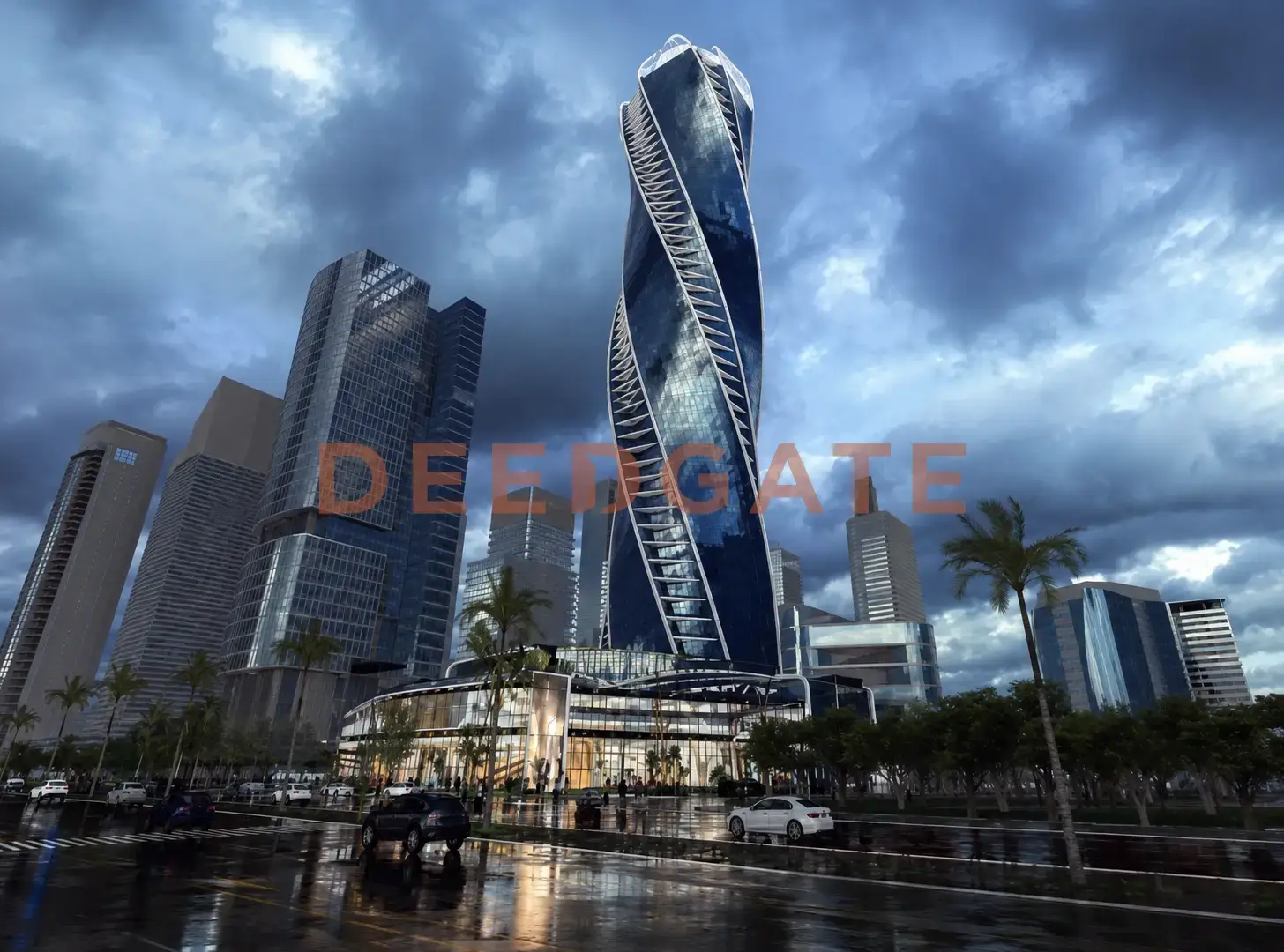
Capital Diamond Tower New Capital is the first twisted tower built in Egypt and the tallest of its kind in Africa, developed by Amazon Holding on plot CN-09 inside the Central Business District (CBD) of the New Administrative Capital. The tower rises 45 floors above ground with 5 underground levels, and it stacks commercial, administrative, and hotel units into a single building that faces the Iconic Tower and the Green River directly. Its architecture ranks eleventh worldwide by height and sixth by degree of twist, which turns every floor into a different viewing angle over the capital’s skyline rather than a repeated flat plate.
What sets this tower apart is not a slogan but its position and its mix. Amazon Holding placed a multi-use icon on one of the busiest commercial plots in Downtown, then priced units from 10,843,076 EGP with installments stretching to 10 years and a 10% discount on the price per meter during the launch window. The result targets the investor who wants an address with several income streams inside one structure, from a ground-floor retail unit to a top-floor hotel suite. This page reads the project the way a buyer evaluates it, attribute by attribute, with the numbers reconciled into one consistent set.
Capital Diamond Tower New Capital at a glance
Before the detail, here is the reconciled specification set for the tower in a single reference table. Several English pages about this tower disagree on floor count and height. The figures below follow the developer’s own distribution: 45 floors above ground, 5 underground parking levels, and a 22,000 m² footprint on roughly 5.2 acres.
| Attribute | Value |
|---|---|
| Developer | Amazon Holding (UAE), founded 2000 |
| Location | Central Business District (CBD), Downtown, plot CN-09 |
| Project type | Mixed-use tower (commercial, administrative, hotel) |
| Floors | 45 above ground + 5 underground (parking) |
| Total area | 22,000 m² (about 5.2 acres) |
| Unit types | Commercial, administrative offices, hotel units |
| Starting unit size | Commercial 30 m² / Administrative 49 m² / Hotel 60 m² |
| Starting price | From 10,843,076 EGP per unit |
| Payment plan | 10% down payment, installments up to 10 years |
| Finishing | Administrative and hotel fully finished, commercial semi-finished |
| Facility management | KAD (commercial) and EFS (facilities) |
The twisted design and floor distribution
The tower comprises 45 floors above ground plus 5 underground levels dedicated entirely to the car park. Amazon Holding separated the uses so that no activity crowds another: commercial units occupy the ground floor through the second, the third floor is reserved for services that support those retail units, and administrative offices span from the fourth floor to the thirty-fifth. The final 5 floors hold the luxury hotel units, and for the first time in this class the building assigns two complete floors to restaurants and cafés with open views.
The office plates were engineered column-free, with a structural load ratio between 28% and 30%. A lower load ratio means a larger share of net usable area inside each unit compared with columned offices, which matters for companies that need flexible layouts for workstations and meeting rooms. The twist itself is functional rather than decorative. Because each floor rotates against the one below it, every level gains a distinct view over the capital’s landmarks, and that visual differentiation lifts a unit’s value against the conventional towers next door.
Globally, the tower ranks eleventh by height and sixth by degree of architectural twist, which places it in a small group of rotating high-rises worldwide and makes it the reference point for the form in Egypt and Africa. The stacking logic is what keeps a building of this height workable: five underground levels absorb parking so the ground plane stays clear for retail and arrival, the lower three floors handle commercial and its support services, the long mid-section carries the offices, and the crown holds hospitality and dining. That vertical zoning is the reason a single tower can host three distinct activities without one interfering with another, and it is central to how the tower is meant to operate after handover.
Where is Capital Diamond Tower New Capital located?
The tower sits on plot CN-09 in the Central Business District at the heart of Downtown, directly facing the Iconic Tower and the Green River and close to the North Bin Zayed Axis. This placement puts the tower inside the densest zone of commercial and administrative traffic in the capital, which is the primary condition an investor looks for in leasable units. The CBD concentrates corporations, government-adjacent offices, and hospitality demand in one district, so footfall supports occupancy across the day rather than in a single peak.
On distances, the tower stands roughly 3 minutes from the Green River, about 5 minutes from the monorail station and the Iconic Tower, and near 15 minutes from the Government District. Proximity to the North Bin Zayed Axis links the tower to the main road network connecting the New Administrative Capital with Greater Cairo, which eases arrival for clients, staff, and hotel guests from several directions. For a mixed-use asset, that multi-directional access is what keeps commercial, office, and hotel occupancy steady, and it is a stronger location signal than the phrase “prime location” that competing pages lean on.
Access is not only about the roads outside but about how arrivals are absorbed inside. The 5 underground levels dedicated to parking pull cars off the street and away from the tower entrance, which matters in a district where three activities generate traffic across the day. The monorail station within 5 minutes adds a transit option that reduces reliance on private cars for office workers and visitors, a factor that supports occupancy in a mixed-use building. Facing the Iconic Tower and the Green River, the tower also gains the address recognition that helps a commercial or hotel unit compete for tenants and guests in a district still filling in.
| Landmark | Approximate distance |
|---|---|
| Green River | 3 minutes |
| Monorail station | 5 minutes |
| Iconic Tower | 5 minutes |
| Government District | 15 minutes |
| North Bin Zayed Axis | Direct link |
The New Administrative Capital and the CBD district
The New Administrative Capital is Egypt’s new government and business hub east of Cairo, planned to relieve density on the older city and to house ministries, the parliament, and the country’s largest concentration of new high-rise development. Within it, the Central Business District is the commercial spine, a cluster of towers designed as the capital’s financial and corporate center, anchored by the Iconic Tower, the tallest tower in Africa. The tower sits inside this district on plot CN-09, which places it among the addresses that draw the earliest corporate and institutional tenants.
Two features of the CBD shape a unit’s long-term value here. First, the district is built to a single master plan, so infrastructure, road access, and transit arrive together rather than piecemeal, which shortens the gap between purchase and a functioning commercial environment. Second, the CBD carries the capital’s transit backbone, with the monorail station near the tower connecting the district to Greater Cairo. A tower that is 5 minutes from that station and directly on the North Bin Zayed Axis inherits the district’s accessibility, and that accessibility is what converts a well-located building into a leasable, occupied one. Buyers evaluating the tower are effectively buying into the CBD’s trajectory, not just a single plot.
Unit types and sizes
The tower was built on 22,000 m² (about 5.2 acres), and its units span commercial, administrative, and hotel categories to suit more than one investor segment. Commercial spaces start from 30 m², administrative units from 49 m², and hotel units from 60 m², a gradient that runs from a compact shop to a full hotel suite. Each activity carries its own price per meter because the position and finishing differ, and the table below sets the three side by side after the launch discount.
The starting sizes matter because they set the minimum ticket for each activity. A 30 m² commercial unit is small enough to bring a storefront within reach of an individual retailer or a franchise, while a 49 m² office is sized for a compact company or a branch rather than a single desk. The 60 m² hotel unit is scaled as a rentable suite rather than a room, which fits the short-term rental model the upper floors are built for. Because the tower offers a spread of sizes within each activity rather than a single fixed unit, a buyer can match the purchase to a budget and a target tenant instead of taking whatever is available.
| Unit type | Starting size | Price per m² (after launch discount) | Floors |
|---|---|---|---|
| Commercial | 30 m² | 100,000 EGP | Ground to 2nd |
| Administrative | 49 m² | 212,000 EGP | 4th to 35th |
| Hotel | 60 m² | 200,000 EGP | Last 5 floors |
The gap in price per meter between the three activities reflects the nature of each use. The administrative meter is the highest because it sits in the column-free office floors, while the hotel meter runs close behind it, tied to the upper floors and their views. The commercial meter starts from a lower band on the high-traffic ground floors, where turnover rather than height drives value. A buyer choosing between the three is really choosing between footfall, flexible floor plates, and elevation, and the pricing follows that logic rather than a flat rate across the tower.
The commercial units occupy the ground floor through the second, the busiest levels for retail and the point where a drive-thru and a giant LED screen concentrate visibility. Starting from 30 m², these units target brands that want a storefront in a high-traffic tower and are willing to fit out a semi-finished space to their own identity. Because they sit at street level in a district built for footfall, their value tracks the flow of visitors and the mix of tenants around them rather than the height of the floor.
The administrative offices run from the fourth floor to the thirty-fifth and are the tower’s core by floor count. Starting from 49 m² and engineered column-free, they give companies open plates that divide into workstations and meeting rooms without structural obstruction, and they arrive fully finished. This unit type suits a company that wants a headquarters address in the CBD with a delivered, ready-to-occupy office, and it is the activity where the tower’s load ratio of 28% to 30% translates most directly into usable area.
The hotel units sit on the final 5 floors, the highest in the tower, starting from 60 m² and delivered fully finished. Their position captures the widest views the rotating design produces, and they suit an investor targeting short-term rental income tied to the capital’s business and government traffic. Sitting above two full floors of restaurants and cafés and served by the tower’s health club, the hotel units function as a hospitality layer on top of the commercial and office base rather than a separate operation.
Prices and payment plans for Capital Diamond Tower New Capital in 2026
Prices at the tower start from 10,843,076 EGP per unit, with a 10% discount applied to the price per meter during the launch period. The total value shifts with the activity, the size, and the floor, and prices are updated periodically, so confirming the current figure before signing is the sensible step. Administrative and hotel units are delivered fully finished, while commercial units are handed over semi-finished so each tenant can fit them out to the activity. Amazon Holding released an accessible payment structure that opens at a 10% down payment and extends installments to 10 years, with an expression-of-interest deposit that varies by activity.
Read More: Smart Mall New Capital
- Reservation down payment starting from 10% of the unit value.
- Remaining balance installed over a period reaching 10 years.
- Expression-of-interest (EOI) deposit for commercial units: 100,000 EGP.
- Expression-of-interest (EOI) deposit for administrative and hotel units: 50,000 EGP.
- Launch discount of 10% on the price per meter during the release phase.
The difference in the serious deposit between commercial and administrative activities mirrors the gap in price bands, and it lets an investor pick the activity that fits the budget while keeping the same extended installment term. Because the launch discount applies to the meter rate, the effective saving grows with unit size, so a larger office or hotel suite captures more of the reduction than a small retail unit. These figures reflect the 2026 launch pricing and should be re-checked at the point of contracting.
Read against the wider capital, the entry point of 10,843,076 EGP places the tower in the mid-to-upper commercial band rather than the entry tier, which is consistent with a CBD address and a fully serviced mixed-use building. The 10-year term is longer than the plans many developers offer on commercial units, so the monthly outlay on a given unit is lower than a shorter plan at the same price. A buyer comparing offers should look past the headline price to the down payment, the term length, and the finishing level together, because those three decide the real cash needed at each stage.
Finishing and delivery
Finishing in the tower is split by use. Administrative offices and hotel units are handed over fully finished, ready for immediate operation or fit-out to a company’s identity, while commercial units are delivered semi-finished so each retailer can adapt the space to a specific trade. This split is deliberate: offices and hotel suites benefit from a consistent, delivered standard, whereas a shop needs a blank canvas that a brand can brand. Buyers comparing this tower with other CBD towers should weigh the finishing standard alongside the price per meter, because a fully finished office removes a cost that a semi-finished unit still carries.
The finishing standard also affects how quickly a unit starts earning. A fully finished administrative or hotel unit can be leased or operated soon after handover, which shortens the gap between the final installment and the first rental income. A semi-finished commercial unit needs a fit-out period, so its owner budgets for that stage before a tenant opens. When measuring return, a buyer should read the price per meter together with the finishing level and the expected fit-out cost, rather than the headline meter rate on its own. This is the kind of detail the competing English pages leave out, and it changes the real cost comparison between the three unit types.
Amenities and services
The tower runs a service system built to serve commercial, administrative, and hotel activities together. On the operations and safety side, the building relies on a coordinated set of systems rather than a scattered list, and the essentials are grouped below.
- 10 high-speed elevators serving the full height of the tower.
- 5-level underground garage that keeps congestion away from the tower entrance.
- Central air-conditioning across all units, with fire-alarm, smart lighting, and ventilation systems.
- 24/7 security and surveillance with cameras covering every unit.
- A clean, renewable solar-power system integrated into the tower’s operation.
On the work-and-leisure side, the tower dedicates a full floor of integrated services to support the commercial units, and it adds a health club and gym serving the hotel, administrative, and commercial tenants. The building includes spacious conference and meeting halls, a giant LED advertising screen in the style of Dubai’s malls, and a drive-thru service on the ground floor. Wide landscaped green space wraps the tower and opens up the views from its units, and a central satellite system serves all activities. Two full floors of restaurants and cafés with open views round out the amenity mix, turning the tower into a destination rather than a single-purpose block.
Read More: Mall Nabd New Capital
Read the amenities by who they serve and the design intent becomes clear. The 10 high-speed elevators and the 5-level garage handle the vertical and ground movement that a 45-floor mixed-use tower generates, keeping office workers, shoppers, and hotel guests flowing without bottlenecks at the base. The conference and meeting halls, the health club, and the two dining floors serve the offices and hotel as shared facilities, so a company or a guest gets amenities that a standalone unit could not justify. The drive-thru, the giant LED screen, and the ground-floor retail work for the commercial tenants and the footfall they depend on. The solar-power system, central air-conditioning, smart ventilation, and round-the-clock surveillance are the operating backbone that keeps all three activities running under one standard.
To manage this volume of mixed activities, Amazon Holding contracted KAD to run the commercial facilities, the operator behind major malls such as City Stars, alongside EFS for facility management, which oversees projects for Palm Hills and Emaar Misr. Bringing a specialized facility manager in from the design stage raises operating efficiency and protects a unit’s rental value over the long term, and that is a factor that separates mixed-use towers after handover. None of the English pages competing for this project name the operators, yet the choice of KAD and EFS is a concrete quality signal a buyer can verify. A tower that keeps its common areas, systems, and security to a professional standard holds its lease rates, whereas one that degrades after handover loses tenants and value regardless of its original design.
Amazon Holding, the developer behind the tower
The developer of the tower is Amazon Holding, a UAE company founded in 2000 with more than 20 years of experience in real-estate development across the Arab world. The firm has delivered over 180 investment projects in the Middle East, spanning towers, skyscrapers, and large-scale developments, and its portfolio includes the Diamond Towers in Dubai, Marina Dubai Tower, the Mercury Grand Hotel, and an office tower in Fujairah. That track record in high-rise and mixed-use work is directly relevant here, because it lowers the execution risk tied to a building of this height and architectural complexity.
Amazon Holding’s portfolio is weighted toward the exact kind of building it is delivering here. The Diamond Towers in Dubai are a series of high-rise developments, Marina Dubai Tower sits in one of the region’s densest waterfront districts, and the Mercury Grand Hotel adds hospitality operation to the record, while the Fujairah office tower covers the administrative side. Each of these maps onto one of the three activities inside the tower, which means the developer is not entering an unfamiliar building type but repeating a model it has executed across several markets. For a buyer, a portfolio of more than 180 projects over two decades is a track record that can be checked rather than a claim.
The engineering supervision on the tower was handled by two consulting offices, Assad Osman and Moharram-Bakhoum, both established names in tall-building and mixed-use engineering in Egypt. A specialized record in high towers reduces the construction risk that a project of this scale carries, and it gives the buyer a verifiable reference for build quality and delivery. This combination of an experienced developer and named consultants is a stronger credibility signal than the marketing copy on competing pages, which tend to describe the tower’s height without naming who engineered it. Taken together with the KAD and EFS facility contracts, the tower arrives with a defined chain of responsibility from design through construction to post-handover operation.
Is Capital Diamond Tower New Capital a good investment?
The tower draws its investment value from multiple income sources inside one building: commercial units on the high-traffic lower floors, column-free administrative offices in the mid-section, and hotel units on the upper floors with their views. This mix spreads risk across more than one activity and lets an investor pick the segment that matches available capital. Its position in the Central Business District, opposite the Iconic Tower, sits where corporations and institutions cluster, which supports rental demand and the prospect of value appreciation as the district completes.
Three grounded factors support the case. The location inside a master-planned CBD, where infrastructure and transit arrive together, links the tower to the district’s appreciation as corporate occupancy rises. The developer’s record of more than 180 projects and the named engineering consultants lower the execution risk that a building of this height carries, and the KAD and EFS contracts protect operating quality after handover, which is what sustains a lease rate over time. The 10-year installment plan with a 10% down payment lowers the entry barrier relative to paying in full, so an investor can hold a CBD unit while spreading the cost. Each of these rests on a stated fact rather than a projection.
The tower suits an investor seeking a unit in an iconic building with a high rental value, whether a commercial unit for a retail brand, an administrative office for a company, or a hotel unit for short-term rental. A retail investor here is betting on footfall in a district built for it, an office investor on corporate demand for column-free space with a CBD address, and a hotel investor on the capital’s business and government travel. On the other side, the price range opens at around 10.8 million EGP, a band aimed more at the medium-to-large investor than the individual buyer on a limited budget, and the commercial units carry a fit-out cost that a fully finished office or hotel unit does not. Confirming the current price per meter and the delivery timeline remains a necessary step before deciding. This analysis is for guidance only and is not investment advice.
How Capital Diamond Tower New Capital compares in the CBD
Within the Central Business District, most towers offer a single dominant use, either offices or retail, whereas the tower combines three activities under one roof and one facility-management structure. That consolidation matters for an investor who wants diversification without buying into three separate buildings. The tower’s direct frontage on the Iconic Tower and the Green River also places it among the most visible plots in the district, and its twisted form makes it recognizable from a distance, which supports both retail footfall and hotel positioning.
Compared with conventional towers nearby, the column-free office floors and the rotating plates give tenants larger usable areas and varied views, two attributes that translate into leasing advantages. For buyers weighing this tower against other New Capital malls and towers, the deciding factors are the multi-use income model, the named facility operators, and the launch pricing with a 10-year plan, rather than height alone. These are the levers that hold value after the district matures and the initial launch discounts close.
Read More: Mall One Bay New Capital
Frequently asked questions about Capital Diamond Tower New Capital
How much does a unit at Capital Diamond Tower New Capital cost?
Prices at Capital Diamond Tower New Capital start from 10,843,076 EGP per unit, with a 10% discount on the price per meter during the launch. The commercial meter starts from 100,000 EGP, the administrative meter from 212,000 EGP, and the hotel meter from 200,000 EGP. Prices are subject to periodic update.
Who is the developer of Capital Diamond Tower New Capital?
The developer of Capital Diamond Tower New Capital is the UAE firm Amazon Holding, founded in 2000 with more than 180 projects across the Middle East and over 20 years of experience. Its work includes the Diamond Towers in Dubai, Marina Dubai Tower, and the Mercury Grand Hotel.
How many floors does the tower have?
Capital Diamond Tower New Capital has 45 floors above ground and 5 underground levels for parking. The floors split into commercial (ground to 2nd), administrative (4th to 35th), and hotel (last 5 floors), and it stands as the first twisted tower in Egypt and the tallest of its kind in Africa.
What are the unit sizes in the tower?
Unit sizes at Capital Diamond Tower New Capital start from 30 m² for commercial, 49 m² for administrative, and 60 m² for hotel units, within a total tower area of 22,000 m². Administrative and hotel units are fully finished, while commercial units are handed over semi-finished for tenant fit-out.
What are the payment plans for the tower?
Capital Diamond Tower New Capital offers a 10% down payment with installments up to 10 years. The expression-of-interest deposit is 100,000 EGP for commercial units and 50,000 EGP for administrative and hotel units, and a 10% launch discount applies to the price per meter during the release phase.
Is the tower fully finished?
Capital Diamond Tower New Capital delivers administrative and hotel units fully finished, ready to operate or fit out, while commercial units are handed over semi-finished so each tenant can adapt the space to its trade. The finishing standard differs by activity rather than applying one level across the tower.
Conclusion
Capital Diamond Tower New Capital brings together a twisted design that makes it the first of its kind in Egypt and the tallest in Africa, a position in the Central Business District facing the Iconic Tower, and a unit mix spanning commercial, administrative, and hotel activities from Amazon Holding, with prices from 10,843,076 EGP and installments up to 10 years. That combination points the tower at investors seeking an iconic asset with several income streams in the heart of the capital. To check updated prices or book a viewing, get in touch through the form on this page.